Where Should Beginners Invest Their First $5,000? A Smart, Real-World Guide That Actually Works

The $5,000 Question That Changes Everything
If you are holding your first $5,000 and wondering where to invest it, you are already ahead of most people.
Most beginners never reach this moment. They spend, they hesitate, or they wait for the “perfect” time that never comes. But here you are, asking the right question at the right stage.
The mistake many beginners make is thinking this decision needs to be perfect. It does not. What it needs to be is intentional, balanced, and repeatable.
Your first $5,000 is not about getting rich overnight. It is about building habits, confidence, and a foundation that compounds for decades. Invest it correctly, and it can change how you earn, save, and grow money for the rest of your life.
So let’s walk through where beginners should invest their first $5,000, without hype, without jargon, and without pretending there is one magic answer.
First, What This $5,000 Is Really For
Before choosing investments, you need to understand the job of this money.
Your first $5,000 should do three things:
- Teach you how investing actually feels
- Reduce future financial stress
- Increase your long-term earning and wealth potential
It is not meant to be a lottery ticket. It is not meant to sit untouched forever. It is meant to work and teach at the same time.
Once you see it this way, the choices become much clearer.
Step One: Secure the Base Before You Invest
Before putting a single dollar into the market, ask yourself one honest question:
“If I lost my income tomorrow, would this $5,000 save me or stress me out?”
If the answer is stress, you need a safety buffer first.
Emergency Fund Comes First
If you do not have at least one to three months of basic expenses saved, your first investment should not be stocks or crypto.
For beginners, a smart starting split often looks like this:
- $1,000–$2,000 in a high-yield savings account
- Kept separate from spending money
- Used only for true emergencies
This is not exciting, but it is powerful. A small emergency fund prevents forced selling, panic decisions, and credit card debt. Those mistakes cost far more than missing a few percentage points of investment returns.
Step Two: Invest in Yourself Before the Market
Here is the part most traditional advice skips.
Before going all-in on stocks, beginners should seriously consider investing a portion of their first $5,000 into themselves.
Why? Because no investment outperforms increasing your income early.
Why Self-Investment Matters So Much Early On
When your income is low or average, market returns help, but they are slow. Increasing your earning power accelerates everything.
Examples of high-return self-investments include:
- Learning a marketable skill
- Career certifications
- Tools that make you more productive
- Coaching or mentorship
- Health and mental performance improvements
Spending $1,000 to gain a skill that raises your income by $10,000 per year beats a 10 percent market return every time.
For beginners, a smart allocation often looks like:
- $500–$1,500 toward self-investment
- Focused on one clear outcome, not multiple distractions
This creates momentum and confidence that carries into every future investment decision.
Step Three: Start With Simple, Boring Market Investing
Now we get to the part everyone expects.
Once your base is secure and you have invested in yourself, the market becomes your long-term wealth engine.
For beginners, simplicity beats sophistication.
Why Index Funds Are Ideal for Beginners
Index funds allow you to invest in hundreds of companies at once, spreading risk automatically.
They are:
- Low cost
- Easy to understand
- Historically reliable over long periods
For most beginners, a broad U.S. market index fund or S&P 500 fund is more than enough to start.
You do not need to pick individual stocks. You do not need to time the market. You do not need complex strategies.
You need consistency.
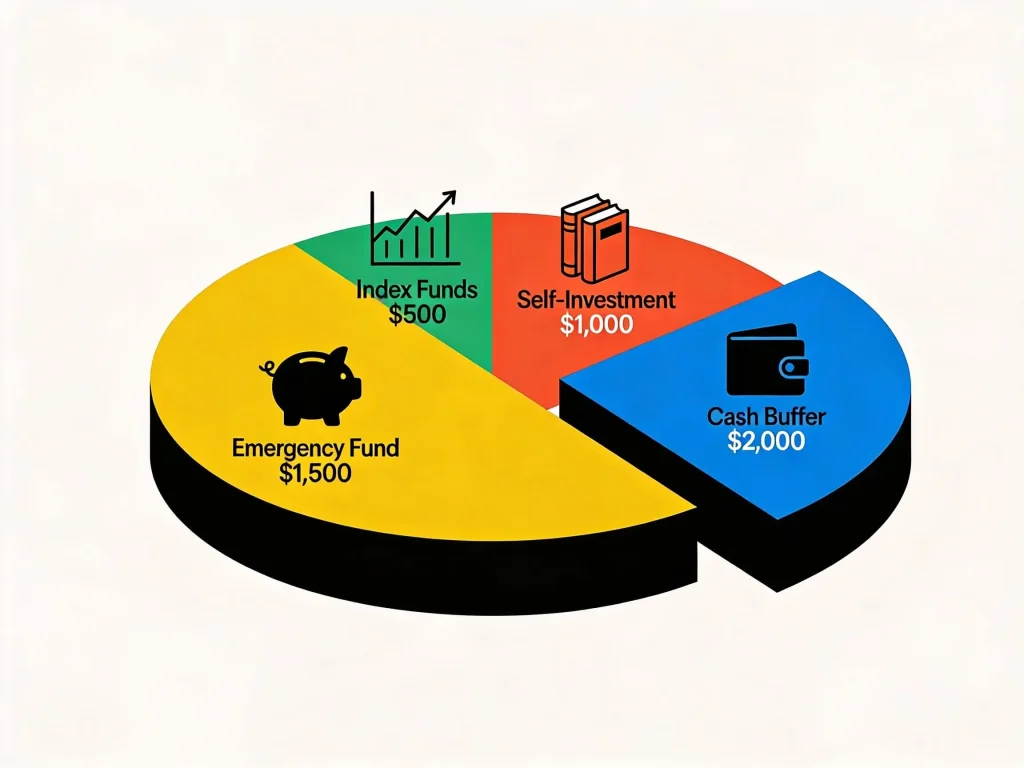
A Smart Beginner Allocation for $5,000
Here is a realistic, balanced example of how beginners could allocate their first $5,000:
| Purpose | Amount |
|---|---|
| Emergency savings | $1,500 |
| Self-investment | $1,000 |
| Index fund investing | $2,000 |
| Cash buffer or learning capital | $500 |
This approach does three important things:
- Protects you from financial shocks
- Increases your income potential
- Starts long-term compounding early
There is no single perfect split, but this framework works because it addresses the whole financial picture, not just returns.
What About High-Risk Investments Like Crypto or Individual Stocks?
This is where beginners often get tempted.
Crypto, meme stocks, options, and speculative assets are exciting, but they are not foundations.
If you are going to explore higher-risk investments, treat them as education, not core strategy.
A good rule for beginners:
- No more than 5–10 percent of your total investable money
- Only money you can emotionally afford to lose
- Never instead of core investing
The goal early on is survival and consistency, not adrenaline.
Common Beginner Mistakes to Avoid
Trying to Optimize Too Early
You do not need the best portfolio. You need one you can stick with.
Waiting for the Perfect Time
There is no perfect entry. Time in the market beats timing the market.
Putting Everything in One Place
Diversification protects beginners from catastrophic mistakes.
Ignoring Behavior
The biggest risk is not the market. It is panic, fear, and overconfidence.
How This First $5,000 Sets Up the Next $50,000
The real value of your first investment is not the return. It is the system you build.
If you learn to:
- Save consistently
- Invest automatically
- Improve your income
- Stay calm during volatility
Your next $5,000 will come faster. Then the next $10,000. Then $50,000.
Wealth is built through repeatable behavior, not one-time decisions.
Frequently Asked Questions
Should beginners invest all $5,000 at once?
If the money is long-term and your emergency fund is secure, investing gradually over a few months can help reduce anxiety. Both lump sum and phased investing work if you stay consistent.
Is it better to invest monthly instead of all at once?
For beginners, monthly investing builds discipline and reduces emotional decision-making.
What if the market crashes after I invest?
Market downturns are normal. Long-term investors benefit from staying invested and continuing to add during dips.
Can beginners lose money investing $5,000?
Yes, in the short term. Over long periods, diversified investing has historically rewarded patience.
Should I hire a financial advisor for $5,000?
Usually not. Simple strategies and self-education are more cost-effective at this stage.
What matters more than returns early on?
Consistency, behavior, and increasing your income.
Disclaimer: This content is for educational purposes only and does not constitute financial advice. Always do your own research or consult a qualified professional before investing.