How Much Money Do You Need to Start Trading in the U.S.? Real Numbers Explained

If you’re in the U.S. and thinking about trading, you’ve probably seen two completely opposite messages:
- “You can start trading with just $10 on your phone!”
- “You need at least $25,000 or you’re wasting your time.”
Both of these can be misleading.
The real answer is more nuanced: how much money you need to start trading depends on your style of trading, your risk tolerance, and your financial situation.
This guide breaks everything down in plain English, with real numbers and examples, so you can decide what’s realistic for you.
Quick note: This article is for education only and is not financial or investment advice. Always do your own research or talk to a licensed professional before making trading decisions.
The Short Answer: Ballpark Numbers for Different Traders
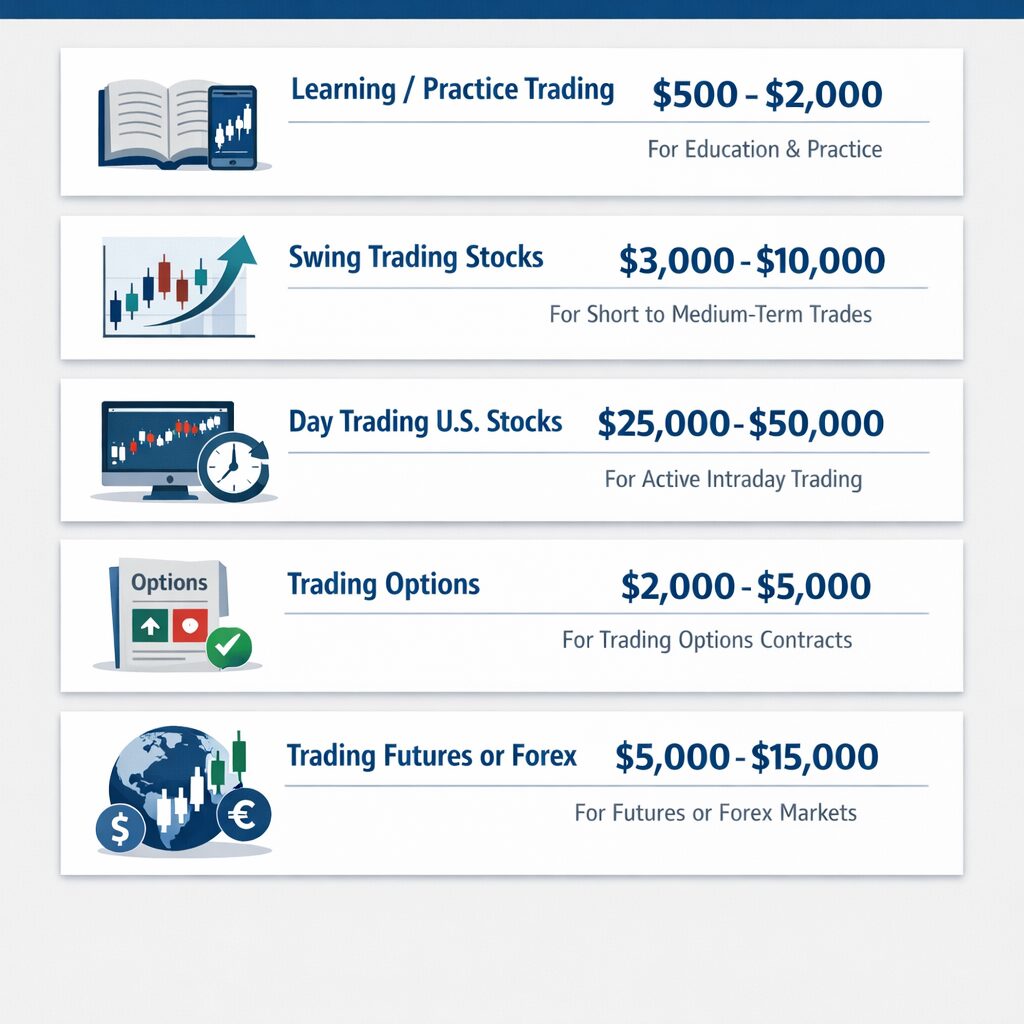
Let’s start with a clear, simple overview. Here’s a rough guide for U.S. traders:
- To learn and practice with real money (no pressure):
$200–$1,000 in a cash account is enough to get experience. - To swing trade stocks part-time (holding for days/weeks):
$1,000–$5,000 is a reasonable minimum to learn proper risk management and make your time worthwhile. - To day trade U.S. stocks actively (in and out same day):
Legally and practically, $25,000+ in a margin account (because of the Pattern Day Trader rule). - To trade options conservatively (simple calls/puts):
Ideally $2,000–$5,000+, though you can technically start with a few hundred dollars. - To scalp or day trade futures/forex with tight risk control:
Often $1,000–$5,000+, but these markets are highly leveraged and dangerous for beginners.
You can trade with less than these numbers, but the smaller you go, the harder it is to manage risk, and the easier it is to blow up your account.
Now let’s unpack why.
Step 1: Decide What “Trading” Actually Means for You
A big source of confusion is that “trading” can mean very different things:
- Day Trading
- In and out of positions the same day
- Often many trades per day
- Fast-paced, screen-intensive
- In the U.S., strongly affected by the Pattern Day Trader (PDT) rule
- Swing Trading
- Holding trades for several days to weeks
- Uses daily/4-hour charts
- Fewer trades, less screen time
- Not limited by PDT if you don’t day trade frequently
- Position Trading / Investing
- Holding for months or years
- More like traditional investing
- Trading frequency is low
- Options, Futures, Forex, Crypto Trading
- Often more leverage
- Lower capital needed to control larger positions
- Much higher risk if you don’t know what you’re doing
The amount of money you need is directly tied to:
- How often you trade
- How big your positions are
- Whether you use margin or leverage
So before you ask, “How much do I need?”, get clear on:
Am I trying to day trade, swing trade, or invest?
U.S. Rules That Affect How Much Money You Need
If you’re a U.S. resident trading U.S. stocks, one rule matters a lot:
The Pattern Day Trader (PDT) Rule
Under FINRA rules, you’re considered a Pattern Day Trader if you:
- Make 4 or more day trades (buy and sell the same stock/ETF on the same day)
- Within 5 business days
- In a margin account
- And those trades are more than 6% of your total trades in that time
If that happens, your broker must flag you as a Pattern Day Trader, and you must keep at least $25,000 in your account (cash + marginable securities). If you fall below that, you can get your account restricted for day trading.
What this means in practice:
- If you want to day trade U.S. stocks frequently in a margin account → plan for $25,000+.
- If you have less than $25,000, you can:
- Use a cash account (no margin; limited by settled funds)
- Avoid frequent same-day round trips
- Focus on swing trading instead of scalping intraday
Cash vs Margin Accounts
- Cash Account
- You trade only with your own cash
- No borrowing from broker
- Limited by settlement times (T+2 for stocks — money from selling isn’t fully available for 2 business days)
- No PDT rule, but you must avoid free riding/settlement violations
- Margin Account
- You can borrow from your broker to trade larger positions
- Subject to the PDT rule if you day trade actively
- Increases both risk and flexibility
For beginners with small capital, a cash account is often safer and simpler.
How Much Money Do You Need to Start Swing Trading Stocks?
Swing trading is a great middle ground for many new traders:
you’re not glued to screens all day, but you’re more active than a passive investor.
Can You Start Swing Trading With $500?
Technically, yes. But there are limitations:
- If you follow healthy risk management (say, risking 1% of your account per trade):
- On $500, 1% = $5 risk per trade
- If your stop loss is $1 away from your entry, you can only buy 5 shares
- A $2 move in your favor = $10 profit (2% of your account)
- Commissions and fees (especially on options) can eat into this quickly
So while you can start with $500, it’s mainly for education and practice, not meaningful income.
A More Realistic Range: $1,000–$5,000
With $1,000–$5,000:
- 1% risk = $10–$50 per trade
- You can buy reasonable share sizes and still follow stop losses
- You can diversify across a few positions
Example with a $3,000 account:
- Risk per trade (1%): $30
- You want to buy a stock at $50 with a stop at $48 (risk = $2/share)
- Position size = $30 / $2 = 15 shares
- If price goes to $56 (profit $6/share), you make $90 (3% of your account)
This is enough to:
- Learn real risk management
- Feel real emotions involved in trading
- Grow slowly if you’re consistent
How Much Money Do You Need to Start Day Trading Stocks?
Day trading is a different beast.
If You Want to Day Trade U.S. Stocks Frequently
Because of the PDT rule, if you want to actively day trade in a margin account, you should plan for:
- $25,000 minimum, and realistically a bit more (e.g., $27,000–$30,000) to stay safely above the threshold after drawdowns.
But having $25,000 doesn’t mean you’re “ready.” It just means you’re legally allowed to day trade frequently. Many traders blow up accounts of that size due to:
- Overtrading
- No strategy
- No risk management
- Emotional decisions
If You Have Less Than $25,000
You still have options:
- Use a cash account and trade less frequently
- You can day trade using only settled funds
- Your buying power resets as trades settle (T+2)
- You might only take a few trades per week
- Focus on swing trading instead of scalping intraday
- This bypasses the PDT problem entirely
- Lower stress, less screen time
- Trade other instruments (futures, forex, crypto)
- These don’t have the PDT rule
- But they are heavily leveraged and easier to blow up with small errors
For most beginners in the U.S., trying to aggressively day trade stocks with a small account is a fast path to frustration.
How Much Do You Need to Start Trading Options?
Options are attractive because they’re cheap in dollar terms but powerful due to leverage.
- 1 options contract usually represents 100 shares of the underlying stock
- A contract might cost $50–$300+ depending on the stock and time to expiration
Technical Minimum vs Practical Minimum
- Technical minimum: You can start with $200–$500
- Maybe you buy 1 cheap contract at a time
- Practical minimum for learning safely:$2,000–$5,000+
- You can size positions and manage risk
- You can absorb a few losing trades without blowing up
Remember:
- Options expire; they can go to zero
- Beginners often underestimate how fast options can lose value
- Commissions and fees for options can be higher than for stocks
If you’re new, consider:
- Starting with simpler strategies (buying calls/puts or covered calls)
- Keeping risk per trade low (1–2% of account)
Risk Management: The Real Driver of How Much You Need
The right amount of capital isn’t just about account minimums.
It’s about what allows you to follow proper risk management.
A common guideline:
- Risk 1% or less of your account on any single trade.
- Advanced or aggressive traders might risk 2%, but more than that is usually asking for trouble.
Example: Why Small Accounts Are So Fragile
Let’s say you have $500:
- 1% risk per trade = $5
- A string of 10 losing trades = $50 loss (10% of your account)
- Emotionally, this can feel huge for many people
With $5,000:
- 1% risk = $50 per trade
- A 10-trade losing streak (which can happen) = $500 (10% drawdown)
- Still painful, but more manageable, and you have more room to learn
The smaller your account, the more:
- Fees and slippage matter
- You’re tempted to over-leverage to “make it worth it”
- A normal losing streak can wipe you out
This is a big reason why starting with some breathing room (e.g., $1,000–$5,000 for swing trading) is helpful.
Costs Many New Traders Forget to Include
When people ask how much they need to start trading, they usually think only of starting capital.
But there are other potential costs:
- Commissions & Fees
- Many U.S. brokers have $0 commissions for stocks/ETFs
- Options still have per-contract fees
- Market Data / Platforms
- Some traders pay for Level II data, scanners, or charting platforms
- Not mandatory for beginners, but nice to have later
- Education
- Books, courses, mentorships (some are helpful, others are pure hype)
- You don’t need expensive courses to start, but you should invest time in learning
- Taxes
- Profits are taxable
- Short-term gains are usually taxed at ordinary income rates
- You may need a tax professional if things get complex
Having extra cash beyond your strict “trading capital” can make this entire journey less stressful.
Example Capital Plans: $1,000 vs $5,000 vs $25,000
Scenario 1: You Have $1,000
Best use case:
- Learn swing trading in a cash account
- Focus on low-cost ETFs or cheaper stocks ($10–$50 range)
- Risk 0.5–1% per trade ($5–$10)
- Goal: Skill-building, not income
Scenario 2: You Have $5,000
Best use case:
- Swing trade stocks more seriously
- Possibly introduce simple options trades with very small size
- Risk 1% per trade ($50)
- Small but meaningful winners possible (e.g., $100–$200 on good trades)
- Still part-time or side income at best until you have a long, profitable track record
Scenario 3: You Have $25,000+
Best use case:
- You can legally day trade stocks actively in a margin account
- Or simply swing trade with more flexibility
- Risk 0.5–1% per trade ($125–$250)
- Potential to generate more meaningful dollar profits, but:
- Losses will also be larger
- Emotional control becomes even more critical
At all levels, the core habits are the same:
risk management, discipline, and a tested strategy.
Growing a Small Account: What’s Realistic?
Many trading ads show tiny accounts turning into millions. That’s marketing, not normal reality.
Reasonable Expectations
- For a new trader, staying breakeven or slightly profitable in the first year is actually a win.
- Once you’re consistent, returns might look like:
- 10–20% per year for conservative traders
- More for skilled, experienced traders taking more risk
- Turning $1,000 into $100,000 in a few years is not realistic for most people without extreme risk (and usually blowing up along the way).
How to Grow Carefully
- Add capital slowly as you prove you can be consistent
- Avoid increasing position size too quickly after a winning streak
- Withdraw some profits occasionally to “pay yourself” and avoid overconfidence
Your time horizon matters too. Are you trying to:
- Learn a skill over 3–5 years, or
- “Get rich” in 3–5 months?
The first mindset is far more likely to succeed.
When You Should Not Start Trading Yet
There are times when the right amount to put into trading is: $0 for now.
Consider waiting if:
- You have high-interest debt (like credit cards at 20%+ APR)
- You don’t have an emergency fund (3–6 months of expenses)
- You’re considering using:
- Rent or mortgage money
- Student loans
- Borrowed money from family/friends
- Retirement funds you can’t afford to lose
Trading involves real risk. You can lose money, including all of what you deposit.
A good rule of thumb:
Only trade with money you can afford to lose without affecting your basic living, debt payments, or long-term financial security.
Checklist Before You Fund Your First Trading Account
Before you send your first dollar to a broker, run through this quick checklist:
- Do I know whether I want to day trade, swing trade, or invest?
- Have I chosen a reputable broker that serves U.S. clients?
- Do I understand the PDT rule and whether it applies to me?
- Do I know how much I’m willing to risk per trade (e.g., 1% of account)?
- Have I practiced on a paper trading account first?
- Do I have no high-interest debt I’m ignoring to trade?
- Am I using only risk capital (money I can afford to lose)?
- Do I have at least a basic written trading plan:
- What I trade (stocks, ETFs, options, etc.)
- Timeframes I use
- Entry and exit criteria
- Risk management rules
If you can’t answer these questions clearly, you don’t necessarily need more money; you need more preparation.
Frequently Asked Questions
Can I start trading with $100?
Yes, some brokers allow you to start trading with as little as $100. However, this amount is best used for learning how trading platforms and orders work, not for generating meaningful income.
Is $1,000 enough to start trading?
$1,000 is enough to learn proper risk management, develop discipline, and gain real trading experience. Profits will be small in dollar terms at first, but it is a realistic starting point for beginners.
Do I really need $25,000 to trade?
No. You only need $25,000 if you want to day trade U.S. stocks frequently in a margin account due to the Pattern Day Trader rule. Swing trading and cash accounts do not require this amount.
What is the safest way to start trading with a small account?
The safest approach is to start with a cash account, risk only one percent or less per trade, and focus on swing trading rather than frequent day trading.
Can I lose all my money when trading?
Yes. Trading involves risk, and it is possible to lose all of the money you deposit. This is why it is important to trade only with money you can afford to lose.
Should I start trading if I have debt?
If you have high-interest debt or no emergency fund, it is generally better to address those first before putting money into trading.
Final Thoughts: Start Smaller, Learn Faster, Risk Less
The real question isn’t just “How much money do I need to start trading?”
It’s: “How much can I afford to lose while I learn this skill properly?”
For many U.S. beginners, a good path looks like this:
- Learn the basics with paper trading (no real money).
- Deposit a small but meaningful amount ($500–$2,000) you can afford to lose.
- Focus on swing trading or simple strategies while you learn risk management.
- Only increase account size after you’ve proven to yourself that you can be consistent.
You don’t need a huge account to start.
You need a clear plan, patience, and respect for risk.
If you tell me your current budget, risk tolerance, and whether you prefer day trading, swing trading, or options, I can help you sketch a personalized starting plan tailored to your situation.
Disclaimer: This article is for educational purposes only and does not constitute financial or investment advice. Trading involves risk, and you can lose money. Always do your own research or consult a licensed financial professional.