How to Price Freelance Services as a Beginner

You finish a project, send the invoice, and then wonder whether you charged too much—or quietly worked for far less than your time was worth. That uncertainty is normal when you are starting out, but it should not become your pricing system.
Learning how to price freelance services as a beginner is less about finding one perfect hourly rate and more about building a repeatable method. You need to understand the client’s result, estimate the work, cover your business costs, protect your time, and communicate the price with confidence.
This guide explains how to choose a pricing model, calculate a minimum sustainable rate, quote projects, handle revisions, and raise your prices without making promises you cannot keep.

Table of Contents
- What Your Freelance Price Must Cover
- Choose the Right Pricing Model
- Calculate Your Minimum Sustainable Rate
- Estimate a Project Price
- Handle Revisions and Scope Changes
- Present Your Quote With Confidence
- Common Beginner Pricing Mistakes
- When to Raise Your Prices
- Frequently Asked Questions
What Your Freelance Price Must Cover
A freelance fee is not the same as a wage. An employee may receive paid leave, employer benefits, equipment, training, and a steady schedule. A freelancer often pays for software, taxes, insurance, payment processing, marketing, unpaid sales calls, administration, and gaps between projects.
| Pricing question | What to include |
|---|---|
| What result are you delivering? | The specific outcome, file, service, or milestone the client receives. |
| How much working time is required? | Delivery time plus research, communication, meetings, revisions, and administration. |
| What business costs apply? | Software, equipment, platform fees, payment fees, travel, subcontractors, and professional services. |
| What risk are you carrying? | Unclear scope, rush deadlines, delayed approvals, cancellations, or specialized responsibility. |
If you are still choosing a service, start with our guide to freelancing jobs that pay well for beginners. Once you know what you offer, pricing becomes a practical exercise rather than a guess.

Choose the Right Pricing Model
Use the model that matches how clearly you can define the work. You can calculate an internal hourly estimate even when you present a project or retainer price to the client.
Hourly Pricing
Hourly pricing works well when the scope is uncertain, the client wants flexible support, or the work is naturally measured by time. It is easy to explain, but it can reward speed less than quality. State what counts as billable time, how you record it, your minimum billing increment, and when invoices are due.
Project Pricing
Project pricing gives the client a clearer budget and lets you charge for the value and responsibility of a defined outcome. It works best when the deliverables, deadline, number of revisions, client responsibilities, and approval process are written down.
Retainer Pricing
A retainer reserves a defined amount of your capacity each month. It can make income more predictable, but only when the agreement explains available hours or deliverables, response times, rollover rules, unused time, cancellation notice, and work outside the retainer.
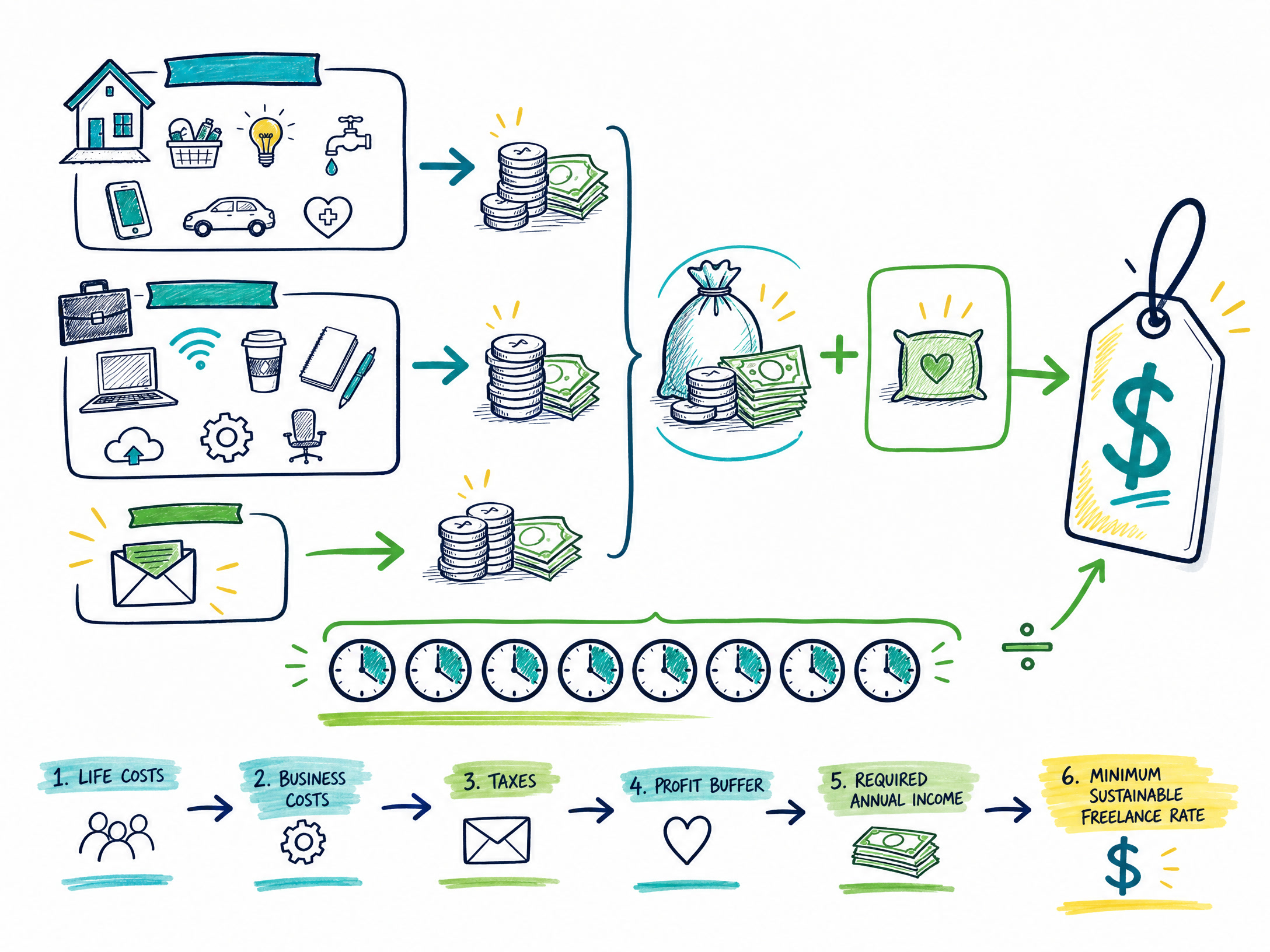
Calculate Your Minimum Sustainable Rate
Do not begin with what another freelancer posts online. Begin with the amount your business needs to support its work. A simple planning formula is:
Minimum hourly rate = (annual personal income goal + annual business costs + tax reserve) ÷ realistic annual billable hours
Billable hours are not every hour you spend working. Sales calls, proposals, learning, bookkeeping, content, and breaks between projects reduce the hours you can invoice. If you expect to work 30 hours per week but can bill only 18 of them, use the lower figure in your planning.
Use FinanceClif’s Budget Planner to map essential household costs while you build your income goal. The tool does not calculate taxes or guarantee freelance income; it simply helps you see the monthly cash flow your work needs to support.
Estimate a Project Price
Once you have a minimum hourly rate, estimate the full project rather than pricing only the visible deliverable. List every task that makes the work possible.
- Write down the deliverables and the client’s definition of finished.
- Estimate research, planning, production, communication, revisions, and delivery time.
- Multiply the estimated hours by your working rate.
- Add direct expenses, platform charges, travel, or subcontractor costs.
- Add a reasonable complexity reserve when the brief is incomplete or the deadline is unusually tight.
- Round the quote to a clear professional number and state what it includes.
| Work component | Estimated time |
|---|---|
| Brief review and planning | Include before production begins. |
| Research or preparation | Count the time needed to understand the client and audience. |
| Creation or delivery | Estimate the actual hands-on work. |
| Revisions | Set a specific number of included rounds. |
| Communication and administration | Include calls, messages, file management, and invoicing. |
For example, a small website copy project may involve more than writing. It may include a discovery call, research, an outline, drafting, editing, two revision rounds, uploading files, and follow-up messages. Pricing only the writing hours creates an artificially low quote.

Handle Revisions and Scope Changes
Many beginners lose money through unlimited revisions. A revision changes or improves the agreed work. A scope change adds new work, new pages, new formats, new research, or a different direction.
Protect the project with a short written scope. State the deliverables, included revisions, deadline, client inputs, payment schedule, and the price for additional work. If the client asks for something outside the agreement, reply before starting it:
“That is outside the current project scope. I can add it for [price] and deliver it by [date]. Would you like me to include it?”
A clear boundary is not hostile. It gives the client a choice and prevents a small request from quietly becoming an unpaid second project.
Present Your Quote With Confidence
Do not bury your price inside a long apology. Explain the result, the scope, the timeline, and the next step. A simple quote can follow this structure:
- Outcome: what the client will receive.
- Scope: what is included and excluded.
- Timeline: when work begins and when the client receives it.
- Investment: the total price, payment schedule, and applicable expenses.
- Next step: how the client approves the work and provides the deposit or information required.
If you use a marketplace such as Upwork, Fiverr, or Contra, review the current platform terms and fees before setting your public price. Your take-home amount may differ from the amount the client sees.
Common Beginner Pricing Mistakes
- Copying someone else’s rate without matching their scope. A specialist with a strong portfolio may include different expertise, speed, risk, and client access.
- Ignoring unpaid work. Proposals, meetings, revisions, and administration still consume capacity.
- Offering too many options. A simple starter package is easier for a first client to understand.
- Discounting without reducing scope. If the budget falls, reduce deliverables or schedule rather than promising the same work for less.
- Starting before payment terms are clear. Put the agreement, deposit, milestones, and cancellation terms in writing.
- Calling revenue profit. Subtract expenses, platform fees, taxes, and the value of your time before judging the result.
When to Raise Your Prices
Raise prices when your current fee no longer reflects the result, responsibility, demand, or time required. Useful signals include a full schedule, repeat referrals, faster delivery without lower quality, a stronger portfolio, improved specialization, or a project that repeatedly takes longer than your quote assumes.
You do not need to change every client at once. Test the new price with new inquiries, review the project outcome, and keep records of time and profit. If your income goal is changing, revisit your household plan and business costs instead of raising prices by instinct alone.
For broader guidance on building online income without relying on hype, see why many people fail to make money online. A sustainable freelance business grows from clear offers, honest delivery, and consistent financial records.
Frequently Asked Questions
Should beginners charge hourly or per project?
Use hourly pricing when the scope is uncertain or the client is buying flexible support. Use project pricing when the outcome and deliverables are clear. Even with a project fee, calculate your internal hourly estimate so you can learn whether the work was sustainable.
How do I price freelance work without experience?
Start with a narrow service, define a small deliverable, estimate the time honestly, and use a written scope. You can offer a limited introductory package, but do not promise unlimited work or describe a discount as a permanent market value.
What if a client says my price is too high?
Ask which part of the scope does not fit the budget. If appropriate, offer a smaller deliverable, longer timeline, or different payment structure. Avoid cutting the price while leaving the workload unchanged.
Should I show my rates online?
A public starting price can filter out poor-fit inquiries and make your offer easier to understand. If every project varies substantially, show package ranges and explain what changes the final quote.
Build a Pricing System You Can Improve
Your first freelance price is a starting hypothesis, not a permanent label. Track the time you expected, the time you actually used, the expenses you paid, the client result, and the parts of the process that created friction. After several projects, the pattern will tell you more than a random rate copied from a social-media post.
Price for the work you deliver, the business costs you carry, and the capacity you need to keep going. Clear scope and honest records will do more for your freelance income than pretending every client is buying an unlimited service.