Zero-Based Budgeting Guide 2026: Benefits and Implementation

Zero-based budgeting sounds complicated, but the idea is simple: give every dollar of expected income a job before you spend it. Your income minus bills, spending, savings, and debt payments should equal zero on paper. That does not mean your bank account must be empty.
A zero-based budget helps you decide where your money should go before the month gets busy. It can also show you when your plan is too tight, when a bill is due before payday, or when you need to reduce spending in one category. A budget is a written plan for your monthly income and expenses. [1]
In this guide: You will learn how zero-based budgeting works, how to build one step by step, how to handle irregular income, and how to decide whether this method fits your life.
Table of contents
- What zero-based budgeting means
- How the method works
- Benefits and limitations
- How to build a zero-based budget
- Worked example: a $4,500 monthly income
- How to budget irregular income
- How to review and adjust the plan
- Frequently asked questions
- Bottom line

Zero-based budgeting is a planning system, not a rule that says you cannot spend money.
What zero-based budgeting means
The basic formula is:
Expected income − planned bills − spending − savings − debt payments = $0 unassigned
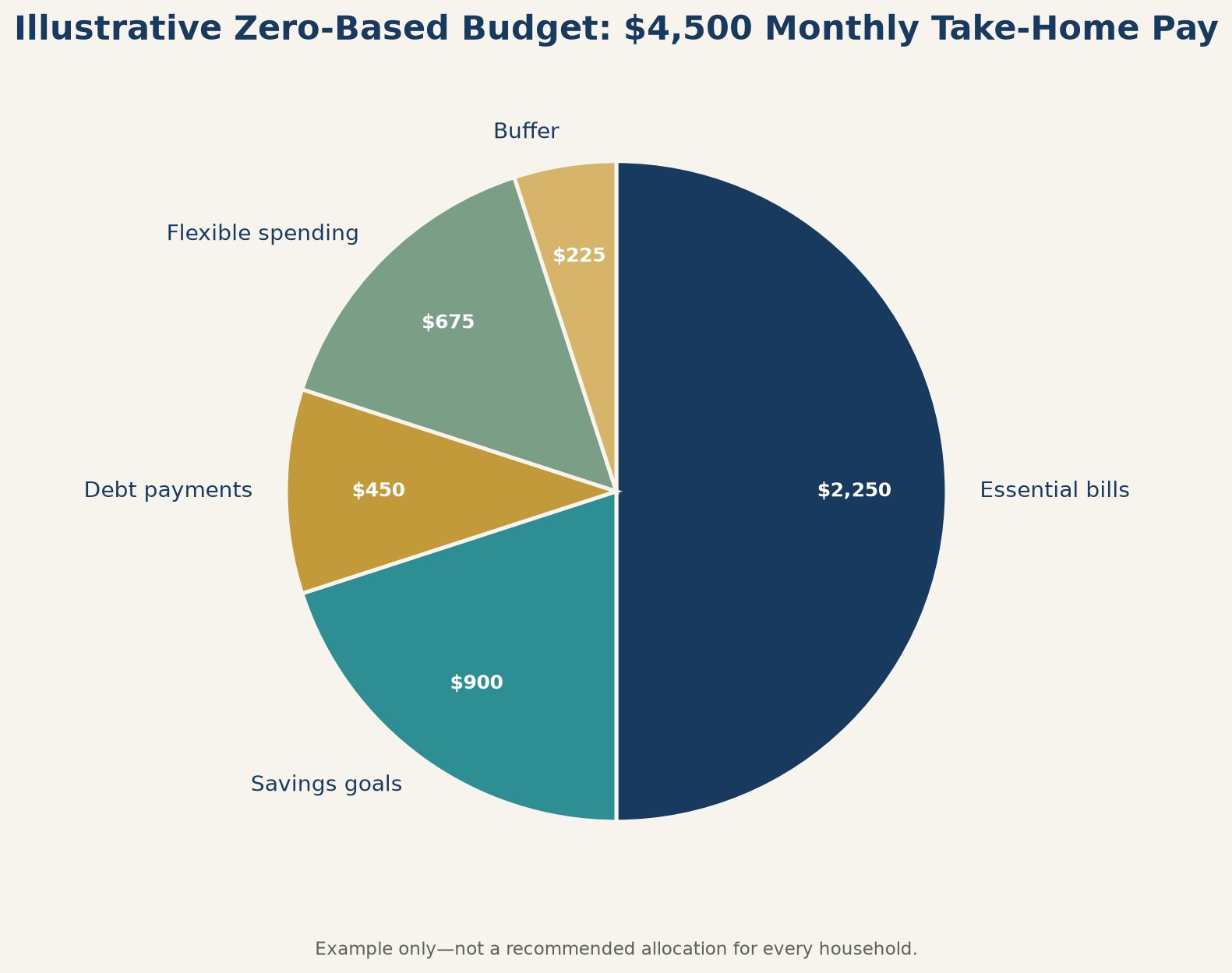
For example, if you expect to take home $4,500, you might assign $2,250 to essential bills, $900 to savings, $450 to debt payments, $675 to flexible spending, and $225 to a buffer. The total is $4,500. Every dollar has a purpose, but the money can still remain in your checking or savings account until you need it.
The method does not require perfect predictions. Your grocery bill may be higher than expected. Your car may need a repair. A budget is a working plan that you update when real life changes.
How the method works
Most people build a zero-based budget at the start of each month. First, estimate the income you expect to receive. Next, list bills, daily spending, savings goals, and debt payments. Then assign money to each category until no income remains unassigned.
That last step is what makes the method different from a loose spending limit. If $300 remains after your first draft, you decide where it should go. You might add it to your emergency fund, make an extra debt payment, set aside money for an annual bill, or use it for planned spending.
A zero balance on paper is not a zero balance in the bank
The phrase “zero-based” causes confusion. You are not trying to spend every dollar immediately. You are assigning every dollar to a category. Money assigned to savings can stay in savings. Money assigned to a future car repair can sit in a separate sinking fund. The plan reaches zero because nothing is left without a job.
Benefits and limitations
It makes trade-offs visible
A zero-based budget forces choices into the open. If you increase restaurant spending, you can see whether the money comes from savings, debt payments, or another category. That makes the cost of a decision easier to understand before you make it.
It supports specific goals
You can give savings a clear purpose instead of treating it as whatever happens to be left at the end of the month. Common categories include an emergency fund, annual insurance, travel, home repairs, tuition, and retirement contributions. For guidance on setting a monthly savings target, see How Much Should You Save Each Month?
It can help with irregular income
People with freelance, commission, seasonal, or hourly income may prefer a fresh plan each month. The method can work with changing income, but it requires conservative estimates and a plan for low-income months. A cash-flow budget can also help you track the timing of income and expenses from week to week. [3]
It takes more maintenance than a simple budget
The trade-off is time. You need to check spending, move money between categories, and update the next month’s plan. If you dislike detailed tracking, a simpler method may be easier to follow. The best budget is the one you can use consistently.
How to build a zero-based budget
Step 1: Estimate your take-home income
Use the money you expect to receive after taxes and payroll deductions. Include paychecks, benefits, support payments, side income, and other reliable sources. Do not count uncertain income until you know when it will arrive.
Step 2: List fixed bills and their due dates
Write down rent or mortgage, utilities, insurance, subscriptions, minimum debt payments, childcare, and other recurring bills. Add the due date beside each one. A budget should track timing as well as totals; a monthly surplus does not help if the money arrives after the bill is due.
Step 3: Estimate variable spending
Review the last two or three months of bank and card activity. Estimate groceries, fuel, medicine, household items, eating out, entertainment, and personal spending. Use actual past spending as a starting point instead of choosing numbers that look ideal.
Step 4: Add savings, annual bills, and debt payments
Give savings and debt payments their own lines. Include your emergency fund, retirement contributions, extra debt payments, and sinking funds for expenses that do not arrive every month. If you need help building emergency savings, see Emergency Fund: How Much Do You Actually Need in 2026?
Step 5: Assign the remaining income
Subtract your planned categories from expected income. If money remains, assign it to a goal or a realistic spending category. If the result is negative, reduce flexible spending, delay a goal, increase income, or revisit a fixed cost. Do not hide the gap by pretending the expense will not happen.
Step 6: Add a small buffer
A buffer gives the plan room for small surprises. It can cover a slightly higher grocery bill, a prescription, or a forgotten school expense. The buffer is still assigned money. If you do not use it, give it a job in the next month’s plan.
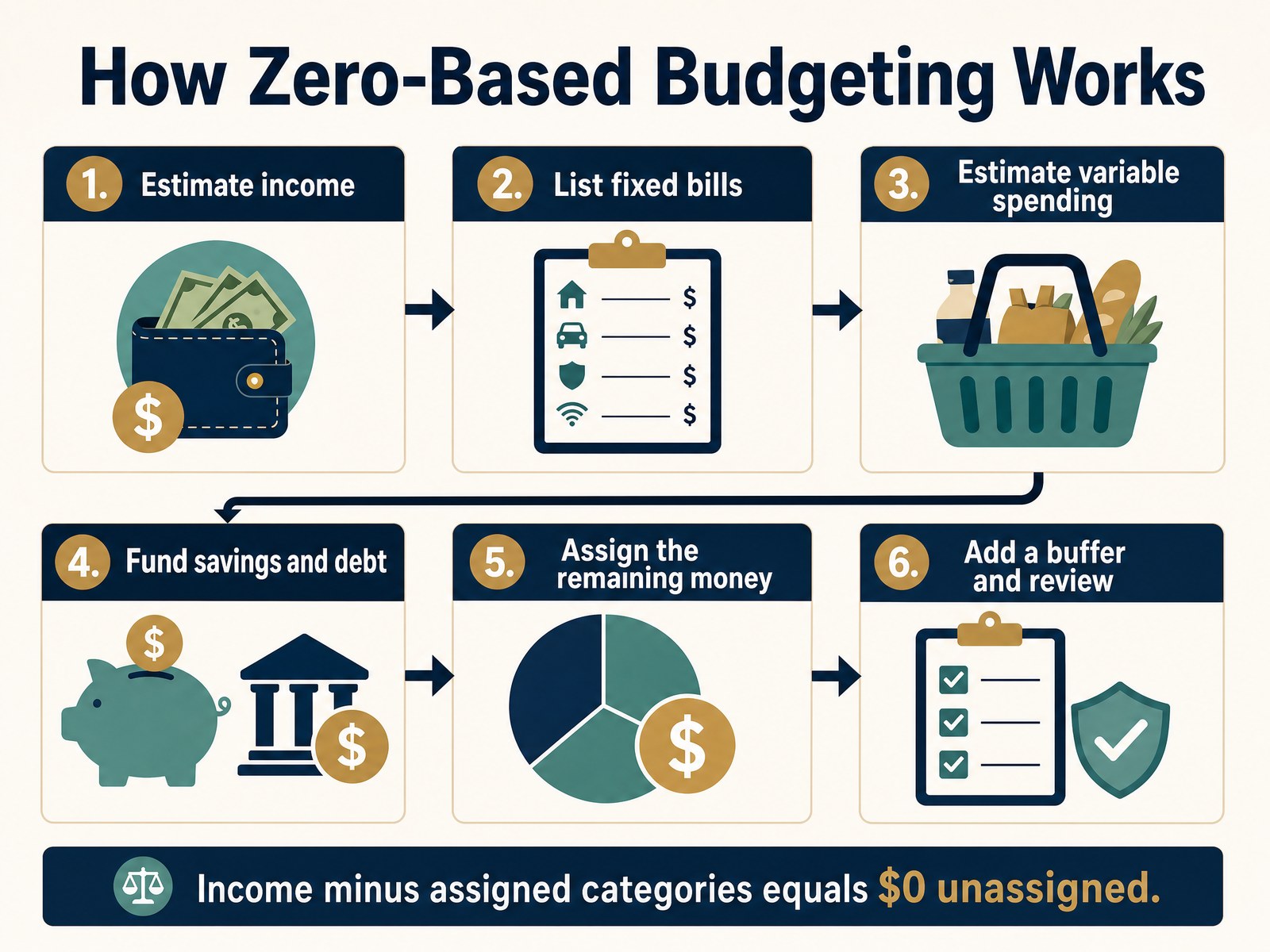
Build the plan in order: income, fixed bills, variable spending, savings, debt payments, and buffer.
Worked example: a $4,500 monthly income
The following example is illustrative. It is not a recommended allocation for every household. Your housing, income, debt, dependents, and goals may require a different plan.
| Category | Planned amount | Purpose |
|---|---|---|
| Essential bills | $2,250 | Housing, utilities, insurance, food, and transport |
| Savings goals | $900 | Emergency fund, annual bills, and short-term goals |
| Debt payments | $450 | Minimum payments plus an extra payment |
| Flexible spending | $675 | Eating out, entertainment, clothing, and personal spending |
| Buffer | $225 | Small surprises and category adjustments |
| Total assigned | $4,500 | $0 remains unassigned |
If the household spends only $150 of the $225 buffer, the remaining $75 does not disappear. It can move to savings, debt, or a future expense. The next month’s plan should reflect what actually happened rather than repeating the original estimates automatically.
How to budget irregular income
Start with a conservative income estimate. You can use last year’s income as a guide, then divide it into a monthly average. Consumer.gov recommends using prior income to estimate a monthly amount when you are not paid every month. [1]
Next, fund the most important categories first: housing, utilities, food, transportation, insurance, minimum debt payments, and essential healthcare. Put flexible spending and optional goals later in the plan. When income is higher than expected, use the extra money for a buffer, future bills, savings, or debt rather than immediately raising recurring expenses.
If income arrives on different dates, use a weekly cash-flow view. Record the starting balance, money received, bills paid, savings, and other spending for each week. The CFPB’s cash-flow tool uses this approach to show whether a household has enough money from week to week. [3]

Reviewing a monthly budget worksheet helps turn estimates into a realistic plan.
How to review and adjust the plan
A budget becomes useful when you compare the plan with real spending. At the end of the month, ask four questions:
- Which categories were higher than expected?
- Which bills or annual expenses did you forget?
- Did the timing of income and bills create a cash shortage?
- What should change in next month’s plan?
Do not treat an over-budget category as a personal failure. Treat it as information. If groceries cost more than expected for three months, raise the grocery category and reduce another category or increase income. A realistic budget is more useful than a perfect-looking budget you cannot follow.
Consumer.gov recommends making a plan at the beginning of the month, tracking spending during the month, and using the results to plan the next one. [1]
Frequently asked questions
What does zero-based budgeting mean?
It means you assign expected income to bills, spending, savings, debt payments, and other purposes until no income remains unassigned. It does not mean you spend every dollar immediately or keep a zero bank balance.
Is zero-based budgeting good for irregular income?
It can work well when you build a fresh plan around conservative income estimates. Use a cash-flow view when the timing of paychecks and bills matters.
How often should I update a zero-based budget?
Review spending during the month and rebuild the plan at least once each month. Update it sooner after a change in income, housing, debt, family responsibilities, or major expenses.
Is zero-based budgeting better than the 50/30/20 rule?
Neither method is always better. Zero-based budgeting gives you more control and detail. A percentage-based approach may take less time. Choose the method you can use consistently and adjust when your situation changes.
What if my expenses are higher than my income?
Start by protecting essential bills, food, transportation, healthcare, and minimum debt payments. Then review flexible spending, recurring subscriptions, due dates, and income options. If the gap is persistent, consider speaking with a qualified financial counselor about your available choices.
Bottom line
Zero-based budgeting gives every dollar a purpose before the month begins. It can make trade-offs visible, support savings and debt goals, and help households with irregular income plan around real cash flow. It also requires regular review, so it is not the best fit for everyone.
Start with one month. Use actual income and recent spending, include a small buffer, and adjust the next plan based on what you learn. For a related guide, read How to Stop Living Paycheck to Paycheck and Emergency Fund: How Much Do You Actually Need in 2026?
Disclosure: This article is educational content, not personalized financial advice. Your budget should reflect your income, obligations, goals, and risk tolerance. Consider a qualified professional for advice about your specific situation.
References