Budgeting With Irregular Income: A Practical Guide

Budgeting with irregular income can feel difficult because the amount or timing of your pay changes from month to month. Freelancers, contractors, commission-based workers, seasonal employees, small-business owners, and people with multiple income sources may not receive the same amount on every payday. The solution is not to guess perfectly. It is to build a cash-flow plan that protects essentials, uses conservative income estimates, and adjusts when the real numbers arrive.
Short answer: Review several months of income, set a conservative planning amount, list expenses by timing and priority, and assign incoming money to the next bills before funding flexible spending. Consumer.gov recommends using prior-year income to estimate a monthly amount when income does not arrive every month. [1]
Table of contents
- What counts as irregular income?
- How to estimate irregular income
- Build a cash-flow budget
- Use a priority order for each payment
- Separate bills, spending, and reserves
- What to do in a strong-income month
- What to do in a low-income month
- Worked example
- Common mistakes to avoid
- Frequently asked questions
- Bottom line

What counts as irregular income?
Irregular income is money that changes in amount, timing, or both. A worker may receive a small base payment plus commissions, a contractor may invoice clients at different times, or a seasonal employee may earn much more during part of the year. A household can also have regular wages plus occasional overtime, tips, bonuses, support payments, or business income.
Separate income that is dependable from income that is possible but uncertain. A recurring paycheck may support a core monthly plan. A bonus, tax refund, or unusually large contract payment should not become a permanent bill unless it is highly predictable. This distinction keeps a low-income month from creating a new debt problem.
How to estimate irregular income
Step 1: Gather a useful history
Collect bank statements, invoices, pay stubs, payment-platform records, and tax records for at least six months. A full year is better when the work is seasonal. Record when money arrived, not only when you earned it, because the timing affects which bills the money can cover.
Step 2: Find a conservative planning number
Add the income you received during the review period and divide by the number of months. You can also use a lower figure if the average includes unusually strong months. Consumer.gov says people who do not get paid every month can add their prior-year income and divide by 12 to estimate monthly income. [1]
Do not treat the estimate as a promise. Review it after each month and change the next month’s plan when the pattern changes. If you owe taxes on self-employment or contract income, reserve that obligation before treating the remainder as available spending money.
Build a cash-flow budget
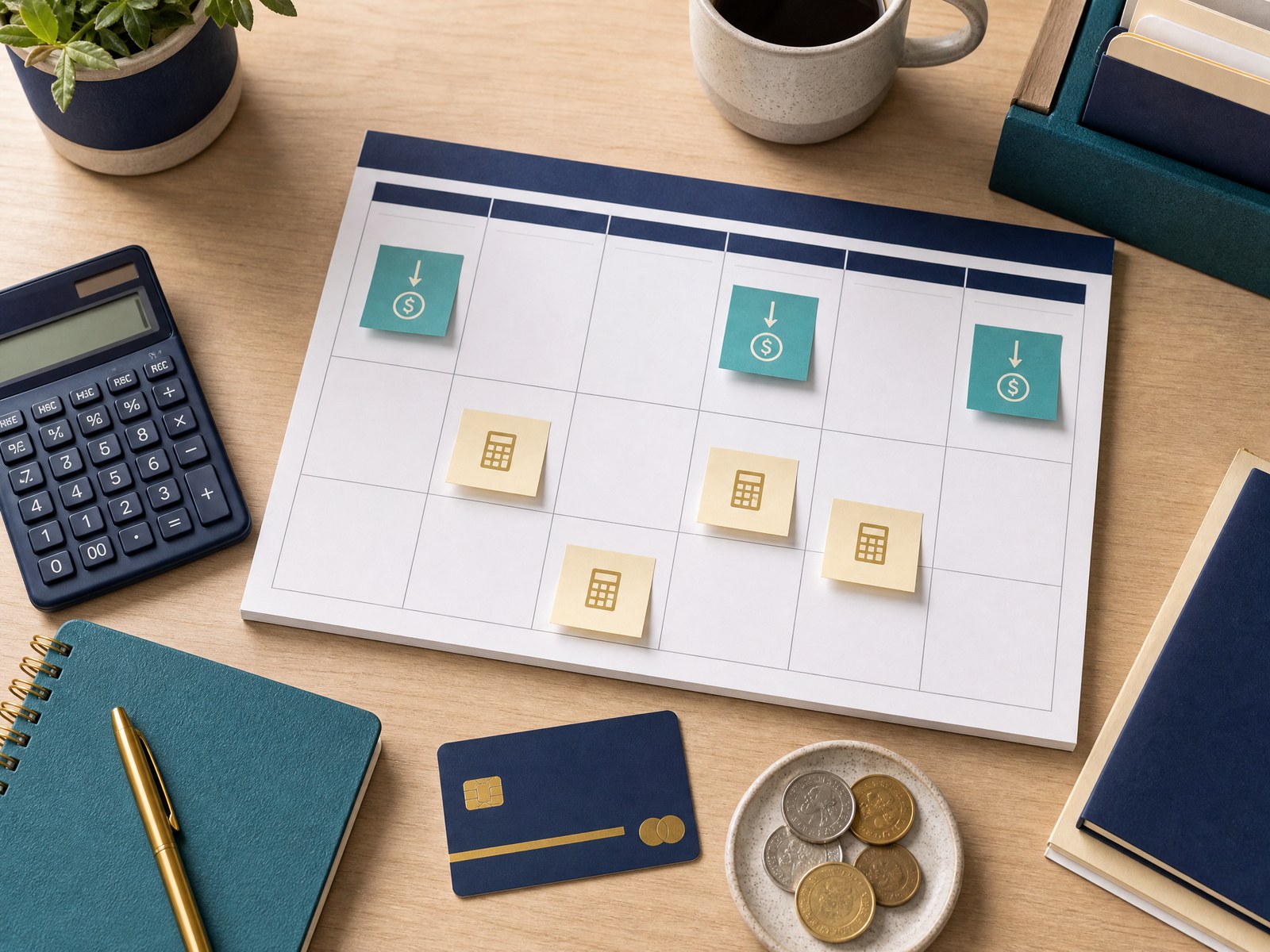
A monthly budget answers, “How much can I spend?” A cash-flow budget also asks, “When will the money arrive, and when will each bill leave?” That timing matters when income is uneven. List expected income and expenses by week or pay period, then check whether the balance remains positive before the next payment arrives.
| Week | Expected income | Planned payments | Available before flexible spending |
|---|---|---|---|
| Week 1 | $1,200 | Rent $900; utilities $150 | $150 |
| Week 2 | $400 | Insurance $120; groceries $180 | $100 |
| Week 3 | $0 | Transportation $100; phone $60 | -$60 before a reserve transfer |
| Week 4 | $650 | Debt minimum $100; groceries $180 | $370 |
This illustration shows why a household can have enough income for the month but still face a shortage in one week. The solution may be to hold back part of Week 1 income for Week 3 bills, change due dates when a provider allows it, or use a cash reserve. The numbers are illustrative and should be replaced with your own timing.
Use a priority order for each payment
When money arrives, assign it in an order that protects housing, utilities, food, transportation, healthcare, insurance, taxes, and required debt payments. Then fund planned expenses and savings goals. Flexible spending comes after the obligations that keep the household safe and functioning.
- Priority 1—Essentials: housing, utilities, food, medicine, transportation, and basic insurance.
- Priority 2—Required obligations: taxes, minimum debt payments, legal obligations, and services needed to earn income.
- Priority 3—Known future costs: annual bills, repairs, school expenses, and other sinking-fund categories.
- Priority 4—Goals and flexibility: extra debt payments, longer-term savings, entertainment, and optional purchases.
This structure is not a reason to ignore every financial goal until income becomes perfect. It is a way to make trade-offs visible. Our zero-based budgeting guide explains how to assign every dollar while still leaving room for changing expenses.
Separate bills, spending, and reserves
Many people find irregular income easier to manage when money has clear jobs. One account or labeled bucket can hold upcoming bills, another can cover everyday spending, and a separate reserve can absorb timing gaps. You do not need several bank accounts if a spreadsheet or envelope system is easier to maintain.
Keep planned expenses separate from emergency savings. A sinking fund is for an expected cost such as annual insurance or holiday spending. An emergency fund is for an unplanned shock. Read our sinking-funds guide and emergency-fund guide for the difference.
What to do in a strong-income month
A stronger month is an opportunity to reduce future pressure, not proof that every month will be stronger. First cover upcoming essentials and required obligations. Then consider tax reserves, a cash-flow buffer, planned expenses, high-interest debt, and longer-term savings. Use a written order so the extra money does not disappear into unplanned spending.
If your income is seasonal, estimate how many low-income months the strong months must support. A reserve that covers only one upcoming bill may not be enough to smooth the entire season. Keep the assumptions visible and review them when your work pattern changes.
What to do in a low-income month
Start with the next seven to fourteen days rather than trying to solve the whole year at once. Protect essentials and required payments, pause optional transfers if necessary, contact providers early when a payment may be late, and review flexible categories. Avoid replacing an ordinary income gap with high-cost credit unless you have considered the total cost and repayment plan.
If you cannot make a debt minimum or essential bill, contact the provider promptly and explain what you can afford. A written plan is safer than ignoring the problem. Our paycheck-to-paycheck action plan covers additional steps for stabilizing cash flow.

Worked example: planning around uneven income
Suppose a contractor received $3,000, $4,500, $2,800, and $5,200 during four recent months. The total is $15,500, and the simple average is $3,875 per month. The contractor may choose a lower planning amount, such as $3,000, while reserving the difference in stronger months. This is an illustration, not a recommended income rule.
If essential monthly costs are $2,500, a $3,000 planning amount leaves $500 for taxes, irregular costs, savings, and debt goals. When income reaches $4,500, the extra $1,500 can be assigned to future bills and reserves instead of immediately increasing recurring lifestyle costs.
Common mistakes to avoid
- Budgeting from the best month: use a conservative estimate that can survive a slower period.
- Ignoring timing: a monthly average does not show whether money arrives before a bill is due.
- Treating bonuses as regular pay: use uncertain income for reserves or one-time goals until the pattern is dependable.
- Forgetting taxes and fees: separate money that is not available for ordinary spending.
- Using too many categories: a simple plan you review is better than a detailed system you abandon.
Frequently asked questions
What is the best budget method for irregular income?
A cash-flow budget is often useful because it tracks when income arrives and when bills are due. You can combine it with zero-based budgeting, a weekly spending plan, labeled savings buckets, or another method that keeps priorities visible.
Should I use my average income or lowest income?
Use a conservative figure that reflects your work pattern and essential obligations. A lower planning amount may reduce the chance of overcommitting, while a yearly average can help with seasonal income. Test the number against real bills and adjust it when your history changes.
How can I save with irregular income?
Start with a contribution that does not threaten essential bills. You can use a percentage of strong-month income, a small recurring amount, or a reserve-first approach. Review the plan after each month instead of assuming the same transfer will always work.
Bottom line
Budgeting with irregular income works best when you plan for timing, not just totals. Use a conservative income estimate, protect essentials and required payments, hold money for future bills, and review the plan whenever the real numbers arrive. A flexible budget is not a failure; it is the structure that makes variable income easier to manage.
Disclosure: This article is educational content, not personalized financial advice. Your budget should reflect your income, obligations, goals, tax situation, and risk tolerance. Consider a qualified professional for advice about your specific circumstances.
References