Sinking Funds: Examples, Formula, and How to Use Them

A sinking fund is money you set aside gradually for a planned expense. Instead of waiting for an annual bill, repair, holiday, or school cost to arrive all at once, you divide the expected amount into smaller contributions. By the due date, the expense has a place in your plan.
Sinking funds are different from emergency funds. A sinking fund is for a cost you can reasonably expect. An emergency fund is for an unplanned financial shock, such as a sudden medical bill, repair, or loss of income. The Consumer Financial Protection Bureau describes emergency savings as cash reserved for unplanned expenses. [1]
Short answer: List a planned expense, estimate the total, subtract any money already saved, divide the remaining amount by the months or paychecks before the due date, and transfer that amount regularly. A sinking fund turns an irregular bill into a predictable line in your budget.
Table of contents
- What are sinking funds?
- Sinking fund vs. emergency fund
- Common sinking-fund categories
- Sinking fund formula: How much should you save?
- How to set one up
- How to use sinking funds with irregular income
- Worked example
- Common mistakes to avoid
- Frequently asked questions
- Bottom line

What are sinking funds?
A sinking fund is a dedicated amount of money for one known or predictable future expense. Sinking funds are designed for planned expenses with an identifiable cost or target date. You can keep it in a separate savings account, a labeled savings bucket, or a clearly tracked category inside your budget. The location matters less than knowing what the money is for and how much remains available.
For example, a $600 holiday budget due in six months requires a planned contribution of $100 per month if you are starting from zero. A $1,200 annual insurance bill due in twelve months requires $100 per month. The calculation changes if you already have money saved or if the due date moves.
Sinking fund vs. emergency fund
| Feature | Sinking fund | Emergency fund |
|---|---|---|
| Purpose | Prepare for a planned or predictable expense | Cover an unplanned expense or financial emergency |
| Examples | Annual insurance, car registration, gifts, travel, repairs you expect | Unexpected medical bill, urgent repair, job loss, or essential-income interruption |
| Timing | Usually has a known target date | Used when an unexpected need occurs |
| Tracking | Often separated by goal or category | Usually kept as a broader cash reserve |
| What happens after use? | Rebuild for the next planned expense | Rebuild after the emergency passes |
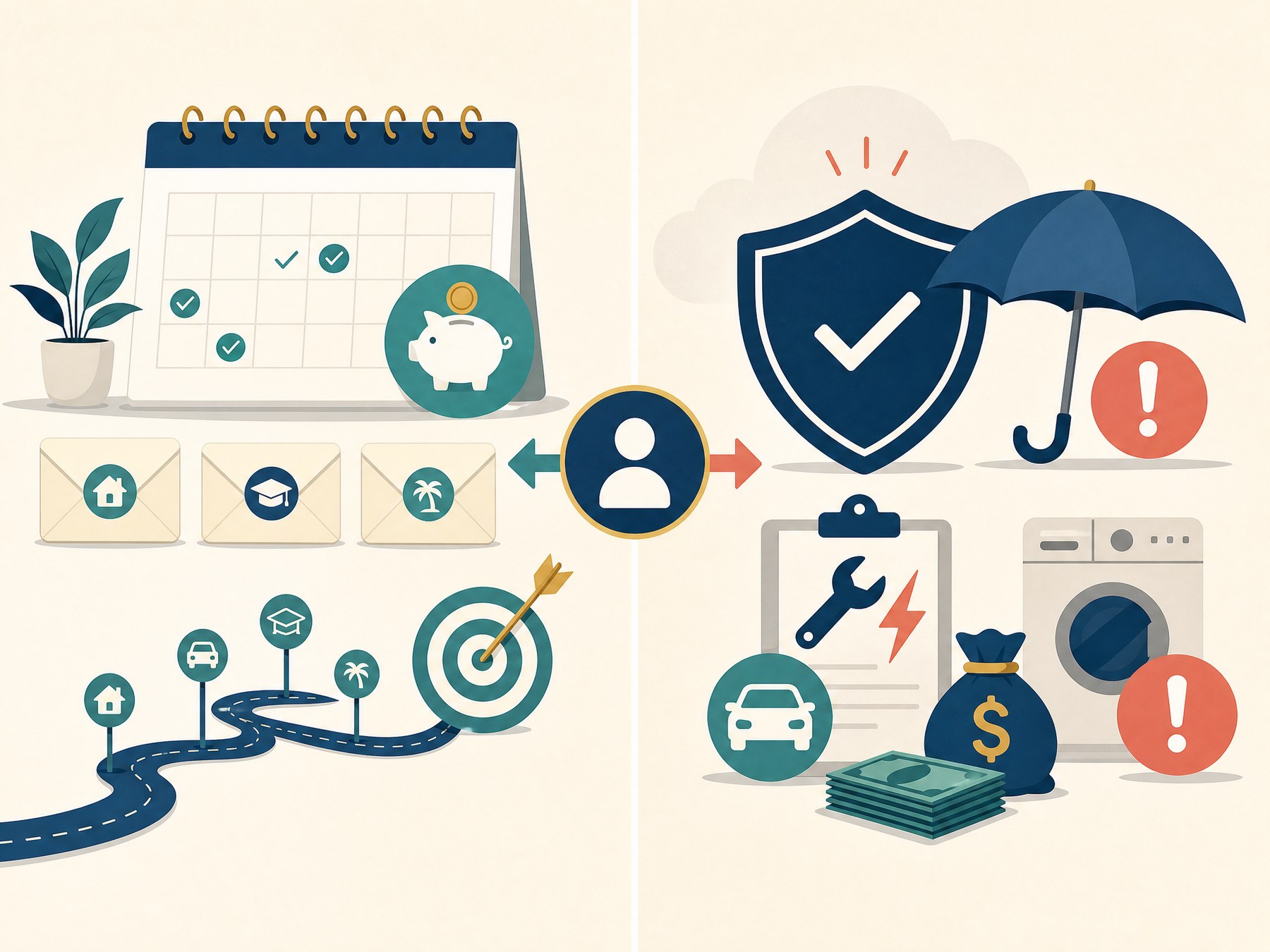
The categories can overlap. A vehicle repair fund may cover maintenance you expect, while the emergency fund can help with a sudden breakdown that is not in the plan. For a broader emergency-savings explanation, see our emergency-fund guide. The key question is whether you could reasonably identify and schedule the cost before it arrived.
Common sinking-fund categories
Start with expenses that are predictable, important, and large enough to disrupt your monthly cash flow. Possible categories include:
- Annual bills: insurance premiums, vehicle registration, memberships, or professional fees.
- Home and vehicle costs: maintenance, tires, appliance replacement, or a repair you know is approaching.
- Family and seasonal spending: school costs, holidays, birthdays, or planned travel.
- Health and personal care: predictable appointments, prescriptions, dental work, or annual premiums.
- Longer-term goals: a move, a course, a major purchase, or a professional certification.
Do not create so many categories that tracking becomes exhausting. Combine smaller goals when they have similar timing or importance. A single “annual bills” fund can be easier to maintain than ten tiny accounts.
Sinking fund formula: How much should you save?
Use this formula:
Monthly contribution = (estimated cost − amount already saved) ÷ months remaining
If you are paid weekly or biweekly, divide the amount by the number of paychecks remaining instead. You can place this formula in a spreadsheet or sinking fund calculator and compare weekly, biweekly, or monthly contributions. Add a reasonable margin if the final cost is uncertain, but label the figure as an estimate. For a budget that combines monthly bills, savings, and debt, read the zero-based budgeting guide.
| Expense | Estimated cost | Already saved | Months left | Monthly contribution |
|---|---|---|---|---|
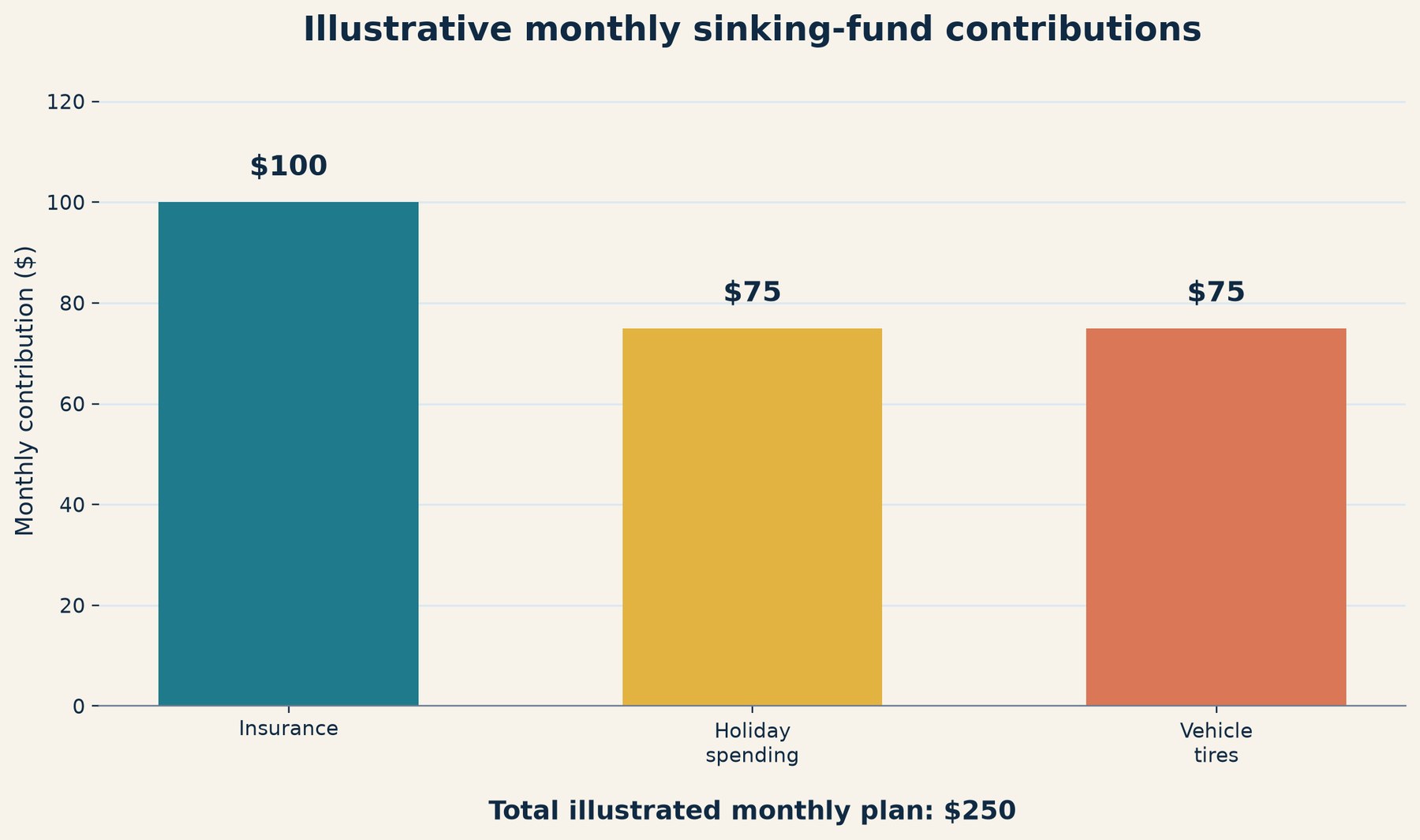
| Annual insurance | $1,200 | $0 | 12 | $100 |
| Holiday spending | $600 | $150 | 6 | $75 |
| Vehicle tires | $800 | $200 | 8 | $75 |
| Total monthly plan | — | — | — | $250 |
The total contribution in this illustration is $250 per month. When a planned expense would otherwise go on a credit card, our credit-card debt payoff guide explains how to stabilize the balance. If that amount does not fit your budget, change the timing, reduce the planned expense, combine categories, or choose which costs matter most. Do not hide the gap by assuming the bill will disappear.
How to set up a sinking fund
Step 1: Review the next twelve months
Look through bills, bank statements, calendars, receipts, and last year’s spending. Write down expenses that do not appear every month but are likely to arrive. Use actual past costs where possible instead of choosing a number that only feels comfortable.
Step 2: Choose the target and due date
Name the category, estimate the amount, and record the date you expect to need the money. If the expense has no date, choose a review month. A target date makes the contribution easier to calculate and adjust.
Step 3: Select a tracking location
You can use separate savings accounts, bank subaccounts, labeled envelopes, or a spreadsheet. Choose a system you will check. The money should be safe, accessible when the planned bill arrives, and clearly separated from everyday spending.
Step 4: Automate or schedule the contribution
Schedule a transfer after a paycheck or on a date that fits your cash flow. Check the account balance and bill timing first. CFPB guidance discusses automatic recurring transfers as one way to build a savings habit, but an automatic transfer should not create an overdraft or prevent an essential bill from being paid. [1]

How to use sinking funds with irregular income
Start with essential and time-sensitive expenses. Use a conservative income estimate, then contribute more in stronger months when the budget allows. If your income changes weekly, use a cash-flow budget to track when money arrives and when contributions or bills leave the account.
When income is lower than expected, pause optional categories before skipping essentials. You can also extend the target date, reduce the planned amount, or split the expense into a smaller first target. Consumer.gov recommends making a monthly plan, tracking spending, and using the results to plan the next month. If cash-flow pressure is making regular contributions difficult, see our paycheck-to-paycheck action plan. [2]
Worked example: preparing for annual expenses
Imagine a household reviewing the next year and identifying three costs: $1,200 for insurance in twelve months, $600 for holiday spending in six months, and $800 for tires in eight months. The household already has $150 for holidays and $200 for tires.
The monthly contributions are $100 for insurance, $75 for holidays, and $75 for tires. The total is $250 per month. If the household cannot spare $250, it should rank the expenses, adjust the targets, or look for a realistic change in timing or income. The calculation makes the trade-off visible.
Common sinking-fund mistakes to avoid
- Confusing planned costs with emergencies: predictable bills belong in a sinking fund; unexpected shocks belong in emergency savings.
- Using optimistic estimates: review past receipts and add a margin when the final cost is uncertain.
- Creating too many categories: use a smaller system you will maintain.
- Forgetting the due date: a monthly amount is meaningful only when it reaches the target before the bill arrives.
- Borrowing from the fund without updating the plan: record the withdrawal and recalculate the remaining contribution.
Frequently asked questions
What is the difference between a sinking fund and savings?
A sinking fund is a form of savings with a specific planned purpose and usually a target date. General savings may not have one assigned expense. The important distinction is how clearly the money is allocated and tracked.
How many sinking funds should I have?
There is no universal number. Start with the two or three predictable expenses most likely to disrupt your cash flow. Add categories only when the benefit of separate tracking exceeds the extra maintenance.
Should sinking funds be separate bank accounts?
Separate accounts can make goals easier to see, but they are not required. A bank’s labeled savings buckets, a spreadsheet, or an envelope system can work if the balances are accurate and the money remains accessible for the planned expense.
Can I use a sinking fund for car repairs?
Yes, if you are saving for maintenance or a repair you can reasonably anticipate. Keep an emergency reserve for an unexpected repair or another financial shock that was not in the plan.
Bottom line
Sinking funds help you prepare for predictable expenses before they become urgent bills. Choose a category, estimate the cost, set a target date, divide the gap into manageable contributions, and review the plan when income or expenses change. Keep planned spending separate from emergency savings so each dollar has a clear job.
Disclosure: This article is educational content, not personalized financial advice. Your savings categories and contribution amounts should reflect your income, obligations, goals, and risk tolerance. Consider a qualified professional for advice about your specific situation.
References