How to Stop Living Paycheck to Paycheck: Practical 2026 Action Plan

Living paycheck to paycheck can feel like a cycle you cannot escape. Money arrives, bills leave, and the account runs low before the next payday. The first step is not a dramatic lifestyle overhaul. It is a clear plan for cash flow, essential bills, emergency savings, debt, and income.
In the Federal Reserve’s 2025 household survey, 63% of adults said they could cover a $400 emergency expense with cash or its equivalent. The result shows why a small emergency reserve matters, but it also shows that financial pressure affects many households. [1]
This guide focuses on practical progress: find the gap, protect essential bills, build a starter buffer, control high-interest debt, automate what you can, and increase income when expense cuts are not enough.
Table of contents
- Why the paycheck-to-paycheck cycle happens
- Step 1: Find the gap
- Step 2: Protect essential spending
- Step 3: Stop the easiest leaks
- Step 4: Build a starter emergency buffer
- Step 5: Choose a debt plan
- Step 6: Automate the next move
- Step 7: Review the income side
- A practical 30-day action plan
- Frequently asked questions
- Bottom line

The goal is not perfection. The goal is to create enough space that one ordinary surprise does not push you into new debt.
Why the paycheck-to-paycheck cycle happens
The cycle usually has more than one cause. Your monthly income may be too close to your required expenses. Bills may arrive before your next paycheck. Irregular costs—car repairs, medical bills, school expenses, annual insurance—may not have a place in the monthly plan. High-interest debt can make the gap wider because interest and fees consume money that could otherwise build a buffer.
This is why “just spend less” is often incomplete advice. You need to know whether the problem is a spending leak, a timing problem, a debt-payment problem, an income gap, or a combination of these. Consumer.gov recommends listing income, bills, and other expenses, then comparing the total with monthly income. [3]
Step 1: Find the gap
Review the last 60 days of bank and credit-card activity. Sort each transaction into a small number of categories: housing, utilities, food, transportation, insurance, healthcare, debt, subscriptions, personal spending, and other.
Do not begin by judging the purchases. Begin by measuring them. Look for three numbers:
- Required monthly expenses: bills you must pay to keep your household safe and functioning.
- Flexible monthly expenses: categories you can reduce, pause, or change.
- Irregular expenses: costs that do not arrive every month but still need funding.
If the timing of income and bills is the issue, build a weekly cash-flow view. A cash-flow budget tracks when money comes in and when expenses go out, which can reveal a shortfall even when monthly totals appear balanced. [4]
Step 2: Protect essential spending
Separate needs from everything else. Essential spending usually includes housing, basic utilities, groceries, transportation to work, insurance, healthcare, and minimum debt payments. The exact list depends on your household.
Protecting essentials does not mean every other purchase is irresponsible. It means you know which expenses must be covered before you make cuts elsewhere. Once essentials are clear, you can make deliberate choices about subscriptions, convenience spending, entertainment, and optional upgrades.
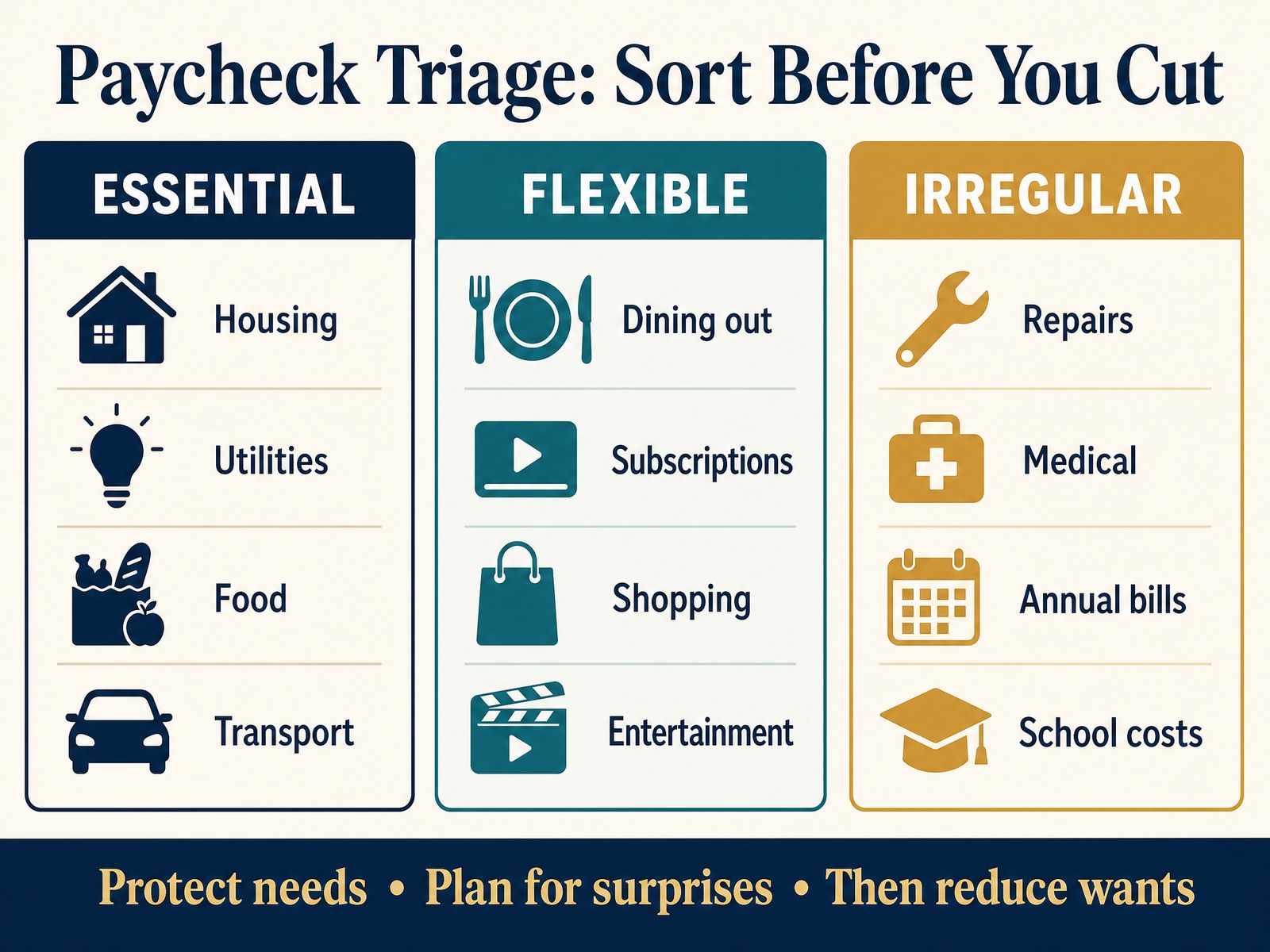
Start with the categories that protect housing, health, transportation, food, and minimum debt obligations.
Step 3: Stop the easiest leaks
Look for savings that do not require changing your entire lifestyle. Cancel forgotten subscriptions. Remove duplicate services. Ask providers whether a lower plan or rate is available. Review bank fees, insurance renewals, delivery fees, and recurring charges that no longer serve you.
Do not assume that every small purchase is the problem. A few large recurring costs can matter more than many small treats. Compare the monthly and annual cost of each recurring charge before deciding what to change.
Step 4: Build a starter emergency buffer
A starter buffer is a small cash reserve for unplanned expenses. A $500 target can be a useful example, but it is not a universal rule. Your first target might be $250, $750, or another amount based on your income, household, and common emergency costs.
The purpose is to reduce the chance that a flat tire, medical bill, or broken appliance immediately becomes credit-card debt. The CFPB describes emergency savings as a reserve for unplanned expenses and notes that even a small amount can provide some financial security. [2]
Keep the buffer safe and accessible. A separate savings account can make the purpose clear while reducing the temptation to spend it. If you use the money for a real emergency, rebuild it later. Using the fund is not failure; it is what the fund is for.

Step 5: Choose a debt plan
Keep making at least the required payment on every debt. Once you have a starter buffer, direct extra money toward one target debt at a time if your budget allows. Two common methods are the avalanche and the snowball:
| Method | How it works | Best fit for |
|---|---|---|
| Avalanche | Pay extra toward the highest interest rate while paying minimums elsewhere. | Borrowers focused on reducing interest cost. |
| Snowball | Pay extra toward the smallest balance while paying minimums elsewhere. | Borrowers who benefit from quick visible wins. |
The avalanche method can reduce interest, but the snowball method may feel easier to maintain. If you are struggling to make minimum payments, stop and contact your lender or servicer before missing one. For federal student-loan decisions, use the student loan repayment guide rather than treating private and federal loans as identical.
Step 6: Automate the next move
Choose one small transfer or payment to automate after payday. It could be $10, $25, or another amount your cash flow can support. The exact amount should be sustainable. Check your checking balance and timing first so an automatic transfer does not cause an overdraft.
The CFPB recommends consistent contributions and identifies automatic recurring transfers as one way to build a savings habit. [2]
Step 7: Review the income side
Expense cuts have a practical limit. If your essential costs already use most of your income, look at ways to increase the amount coming in. Options may include asking for more hours, applying for a higher-paying role, selling unused items, taking short-term work, or checking whether you qualify for available benefits.
Use extra income with a plan. You might split it between the starter buffer, overdue obligations, high-interest debt, and a necessary household expense. Avoid building a recurring expense around income that may not continue.

A practical 30-day action plan
| Week | Focus | Action |
|---|---|---|
| Week 1 | Measure | Review 60 days of transactions and list income, bills, flexible spending, and irregular costs. |
| Week 2 | Protect | Separate essential spending, cancel or renegotiate easy leaks, and identify bill-timing problems. |
| Week 3 | Build | Choose a starter-buffer target and set one sustainable automatic transfer or payment. |
| Week 4 | Continue | Choose a debt target, review income options, and create next month’s plan. |
Do not try to change every category at once. A plan that you can repeat for three months is more useful than a strict plan that lasts three days. For a related budgeting method, read the zero-based budgeting guide.
Frequently asked questions
What is the first step to stop living paycheck to paycheck?
Review the last 60 days of spending and compare required expenses with income. You need to know whether the main issue is spending, timing, debt, income, or a combination.
Should I save or pay off debt first?
Many households benefit from building a small emergency buffer before directing extra money to debt. Continue required payments, then choose a debt method that fits your interest costs and motivation. The right order depends on your cash flow, rates, and risk of another emergency.
How much should I automate if money is tight?
Start with an amount that does not create a cash shortage. It may be $10 or $25 per paycheck, or nothing until essential bills are stable. Increase it only after you have reviewed your actual cash flow.
Is cutting expenses enough?
Sometimes, but not always. If essential costs are already close to income, reducing small purchases will not solve the full gap. Combine reasonable cuts with bill negotiation, income growth, benefit screening, or debt assistance.
How much emergency savings do I need?
There is no single number for every household. Start with a realistic amount for a common emergency, then grow the reserve as your income and expenses allow. Your first target and your long-term emergency fund do not have to be the same.
Bottom line
Breaking the paycheck-to-paycheck cycle usually happens through repeatable steps rather than one dramatic change. Measure the gap, protect essentials, stop easy leaks, build a starter buffer, choose a debt plan, automate one sustainable action, and review the income side.
Begin with one month of clear information. Use your real income and spending, make room for irregular bills, and adjust the next month’s plan based on what you learn. Progress is not measured by perfection; it is measured by having more choices when the next surprise arrives.
Disclosure: This article is educational content, not personalized financial advice. Your plan should reflect your income, obligations, goals, and risk tolerance. Consider a qualified professional or nonprofit financial counselor for help with your specific situation.
References