Student Loan Repayment Guide: Federal vs. Private, Forgiveness & Plans

If you need a student loan repayment guide, start by identifying each loan as federal or private. The two types follow different rules. Federal loans may offer income-driven plans, deferment, forbearance, and forgiveness or discharge programs. Private loans follow the contract you signed with the lender.
Use federal benefits before considering private refinancing. Choose a repayment plan based on your income, loan type, forgiveness goals, and ability to pay. Federal rules changed in August 2026. New federal borrowers may choose RAP or the Tiered Standard plan. Borrowers with only older federal loans may keep access to some legacy plans. 1
This guide compares federal and private repayment, explains the main federal plans, summarizes forgiveness options, and gives you a checklist for your next step. For broader budgeting context, see 10 Personal Finance Rules Every Adult Needs in 2026.
Table of contents
- Federal vs. private student loans: the key differences
- How to choose a federal student loan repayment plan in 2026
- Can student loans be forgiven?
- How private student loan repayment works
- Should you refinance federal student loans?
- A practical student loan repayment checklist
- Frequently asked questions
- Bottom line

Federal and private student loans require different repayment strategies, so identify each loan before choosing a plan.
Federal vs. private student loans: the key differences
First, determine which rules apply to each loan. Federal loans are backed by the U.S. government and use standardized programs. Private loans come from banks, credit unions, online lenders, or state-affiliated organizations. Their terms depend mainly on the loan agreement.
| Feature | Federal student loans | Private student loans |
|---|---|---|
| Repayment plans | Multiple federal plans, including income-driven options for eligible borrowers | Options depend on the lender and contract; income-based payments are uncommon |
| Payment relief | Federal deferment, forbearance, and income-driven plans may be available | Relief is not required; ask the lender about hardship options, extensions, deferment, or forbearance |
| Forgiveness | Some borrowers may qualify for IDR forgiveness, PSLF, teacher relief, or other federal discharge programs | Private loans generally do not qualify for federal forgiveness programs |
| Interest rates | Federal loans generally use fixed rates set under federal rules | Rates may be fixed or variable and depend partly on credit history |
| Refinancing risk | Refinancing into a private loan can remove federal protections and cannot generally be undone | Refinancing may lower the rate or release a co-signer, but a longer term can increase total interest |
| Default options | Federal borrowers may have rehabilitation or consolidation paths out of default | Options vary by lender; negotiate directly and act quickly |
| Where to start | Review your loans at StudentAid.gov and use the Loan Simulator | Read your promissory note and contact the lender or servicer |
The Consumer Financial Protection Bureau advises borrowers to think carefully before refinancing federal loans with a private lender because the change can eliminate federal income-driven repayment, deferment, forbearance, cancellation, and forgiveness protections. 3
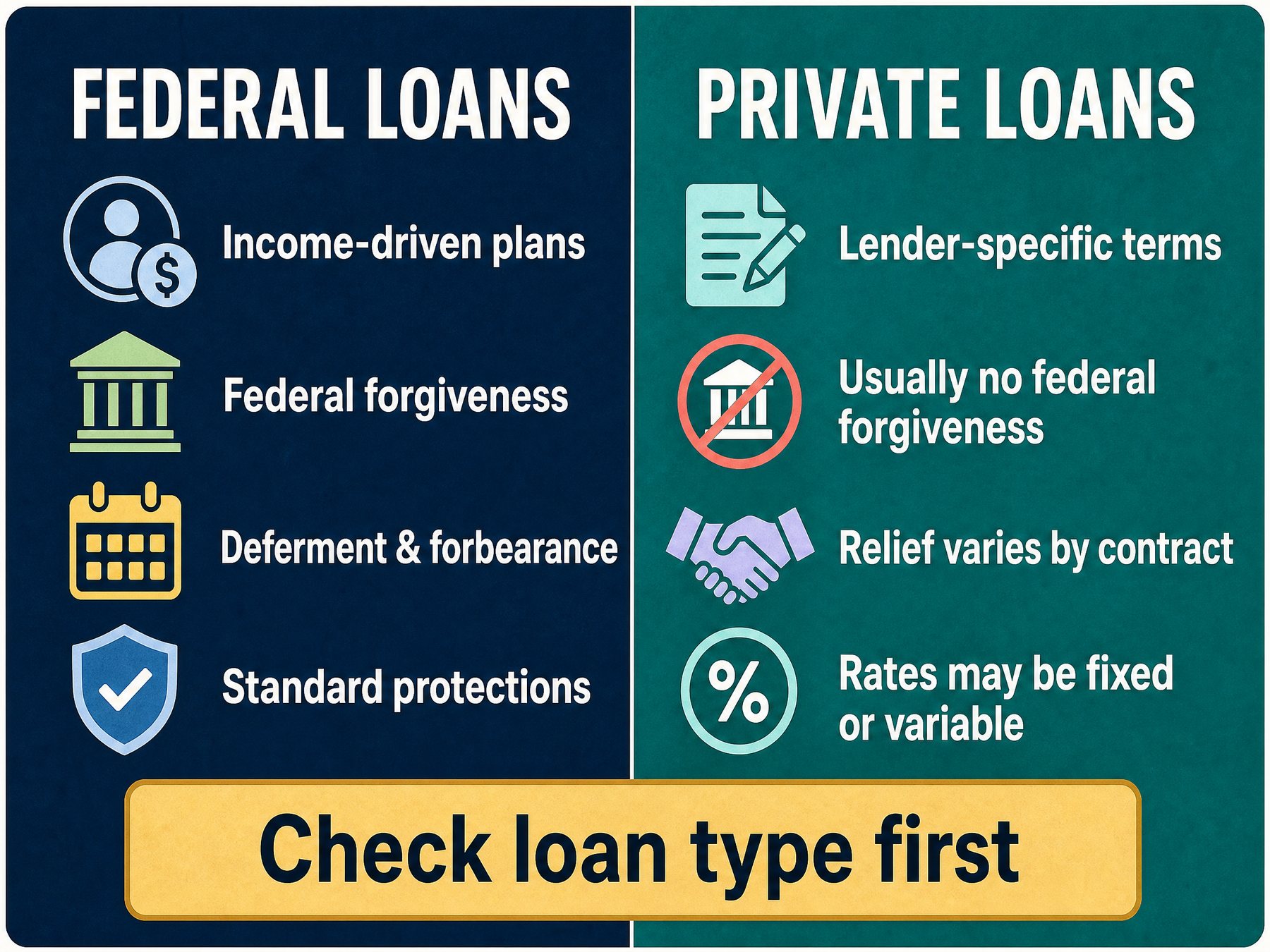
Federal loans generally offer more standardized relief and forgiveness pathways; private loans depend more heavily on the lender’s contract.
How to choose a federal student loan repayment plan in 2026
Your available federal plans depend on your loan type, borrowing history, and when you received the loan. The Department of Education introduced RAP and the Tiered Standard plan on July 1, 2026. Borrowers with only older loans may keep some legacy options. Other changes are scheduled by July 1, 2028. 1
Do not choose a plan solely because it produces the lowest first payment. A lower payment can extend the repayment period and increase total interest. If you are pursuing forgiveness, the plan’s qualifying rules matter more than the lowest monthly bill.
Repayment Assistance Plan (RAP)
RAP is a new income-driven plan. Its payment uses adjusted gross income. It also reduces the payment by $50 for each dependent and uses a 30-year repayment period. The basic formula is 1% to 10% of adjusted gross income divided by 12, minus $50 per dependent. 1
Qualified borrowers who make on-time payments may receive two additional benefits: an unpaid-interest waiver and a matching payment toward principal. If a balance remains after 360 qualifying on-time payments, a limited discharge may apply. The plan’s rules determine eligibility. 2
RAP may fit borrowers who: need an income-based payment, expect to repay for a long period, or want a plan designed to prevent an insufficient payment from leaving the principal unchanged. Its 30-year term may cost more over time than a shorter plan, so compare total payments rather than the monthly bill alone.
Tiered Standard repayment plan
The Tiered Standard plan uses fixed payments and sets the maximum repayment term according to the balance when repayment begins. The Department of Education describes terms of 10, 15, 20, or 25 years. 2
| Outstanding principal balance | Maximum Tiered Standard term |
|---|---|
| Less than $25,000 | 10 years |
| $25,000 to $49,999 | 15 years |
| $50,000 to $99,999 | 20 years |
| $100,000 or more | 25 years |
The plan can make a large balance easier to manage than a short fixed schedule, but the longer repayment period can increase total interest. Payments under the Tiered Standard plan do not qualify for PSLF according to the current Federal Student Aid PSLF guidance. 4
Tiered Standard may fit borrowers who: have predictable income, want a fixed payment, and plan to repay the balance in full rather than pursue income-driven forgiveness.
Income-Based Repayment (IBR)
IBR bases payments on discretionary income. The repayment period is generally 20 years for some newer borrowers and 25 years for certain older borrowers. The exact payment percentage depends on when you borrowed and other eligibility rules. 1
IBR can be useful when your income is modest relative to your federal debt, especially if you may qualify for forgiveness after the repayment period. Eligibility still depends on your loan type and personal history, so use the official application rather than relying on a general rule.
Income-Contingent Repayment (ICR)
ICR bases payments on discretionary income and uses a 25-year repayment period under the current comparison. It can matter for some Parent PLUS borrowers after Direct Consolidation. Eligibility rules are specific and changing. 1
The Department of Education says ICR will end no later than July 1, 2028. If you use ICR, check your servicer’s instructions and the latest StudentAid.gov updates. Do not assume the plan will remain available. 1
Pay As You Earn (PAYE)
PAYE uses 10% of discretionary income and a 20-year repayment period under the current comparison. Eligibility depends on your loan type and borrowing history. The Department of Education says PAYE will end no later than July 1, 2028. 1
Standard, graduated, and extended plans
A fixed repayment plan can be straightforward when you can afford the payment and want to minimize the time interest accrues. Graduated or extended plans may lower the initial bill, but they can increase total interest and generally do not provide a path to federal forgiveness. The current plan you can access depends on when your loans were disbursed and other eligibility rules. 1
A quick federal plan comparison
| Plan | Payment basis | Repayment period | Forgiveness or discharge note |
|---|---|---|---|
| RAP | 1%–10% of adjusted gross income, less $50 per dependent | 30 years | Limited discharge may be available after 360 qualifying on-time payments under the plan’s rules |
| IBR | Discretionary income | 20 or 25 years, depending on borrower history | Remaining balance may be discharged after the required qualifying period |
| ICR | Discretionary income | 25 years | Remaining balance may be discharged after the required qualifying period; future availability is changing |
| PAYE | Discretionary income | 20 years | Remaining balance may be discharged after the required qualifying period; future availability is changing |
| Tiered Standard | Fixed payment based on balance and term tier | 10–25 years | Does not qualify for PSLF |
The table is a starting point, not a personalized recommendation. Use the Federal Student Aid Loan Simulator to compare monthly payment, total interest, and projected forgiveness for the plans you actually qualify for. 1
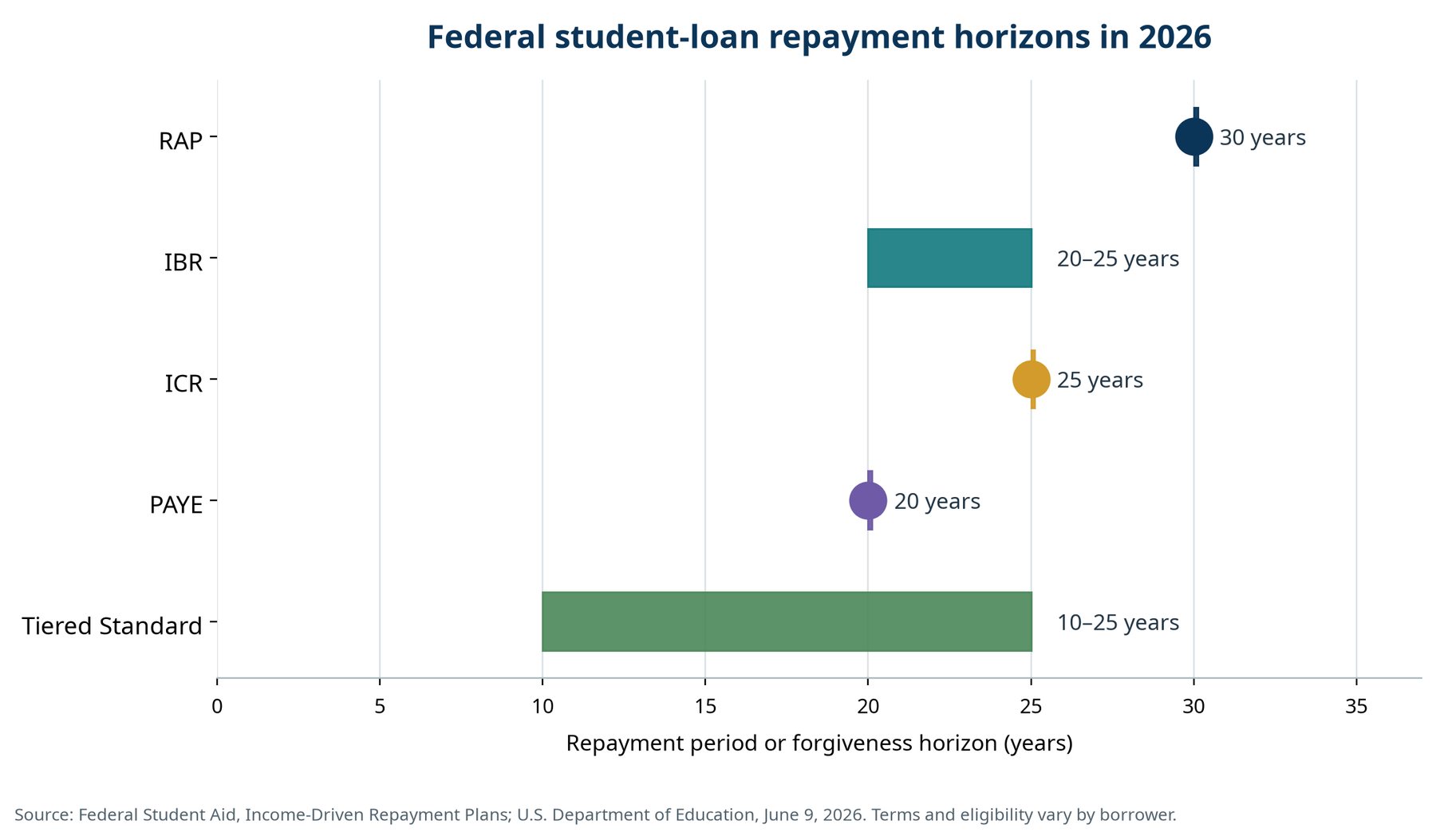
Repayment periods vary by plan and borrower. The chart shows the terms described in current federal guidance, not a personalized payoff estimate.
Can student loans be forgiven?
Federal loans may qualify for forgiveness or discharge; private loans generally do not qualify for federal forgiveness programs. Forgiveness is never automatic merely because you have a federal loan. You must meet the program’s requirements and keep records that prove your eligibility.
Public Service Loan Forgiveness (PSLF)
PSLF may forgive the remaining balance on eligible Direct Loans after you make the equivalent of 120 qualifying monthly payments. You must also work full-time for a qualifying government or nonprofit employer. The payments do not have to be consecutive. 4
For PSLF, the employer matters more than the job title. Qualifying employers can include federal, state, local, or tribal governments; the U.S. military; and some nonprofits. Private education loans do not qualify and cannot be converted into a Direct Consolidation Loan. 4
To protect your progress, use the PSLF Help Tool, certify employment every year and whenever you change employers, and keep copies of payment records. The current Federal Student Aid page also notes a court order affecting certain PSLF changes scheduled for July 1, 2026, so borrowers should check for updated official instructions. 4
Income-driven repayment forgiveness
Under an eligible IDR plan, any remaining federal balance may be discharged after the required repayment period. Depending on the plan and your borrowing history, that period may be 20, 25, or 30 years. 7
IDR forgiveness is not a payment pause. You must stay eligible, update your income and family information when required, and make qualifying payments. If you do not recertify, your payment may rise. You may also lose the income-based calculation. 1
Teacher Loan Forgiveness
Eligible teachers may receive up to $17,500 after five complete and consecutive academic years of full-time teaching. The school or educational service agency must qualify. The amount also depends on the subject taught, school, loan type, and other rules. 8
Teacher Loan Forgiveness and PSLF should be compared carefully. The same period of teaching service generally cannot be used for both programs, and choosing one can affect the other. 8
Other federal discharge programs
Other federal options can include borrower defense to repayment, closed-school discharge, total and permanent disability discharge, military-related benefits, and AmeriCorps education awards. Each program has different eligibility rules and documentation requirements. 7
Private lenders may offer limited death or disability protections, hardship programs, or school-related relief, but these are contract-specific. Do not assume a private loan has the same discharge rights as a federal loan.
How private student loan repayment works
Private repayment depends on the lender, your loan agreement, your interest rate, and your credit profile. Private lenders do not have to offer income-driven payments or hardship relief. If you cannot afford a payment, contact the lender before you miss it. Ask what help is available. 9

For private loans, ask the lender about hardship options, interest accrual, term changes, and co-signer protections before missing a payment.
Possible private-loan options include a temporary forbearance, a deferment, an interest-only period, a longer repayment term, a reduced-payment arrangement, refinancing, or co-signer release. These options can lower the monthly bill while increasing total interest, so ask for the new payment, total cost, duration, interest treatment, and end date in writing. 9
Private student loans are not eligible for PSLF. Refinancing a private loan may be reasonable when it produces a lower total cost and you can afford the new payment, but compare the annual percentage rate, fees, repayment term, variable-rate risk, and co-signer provisions.
Should you refinance federal student loans?
Refinancing a federal loan into a private loan may lower your interest rate. It also replaces federal protections with private-loan terms. The CFPB warns that you may lose access to IDR, federal deferment and forbearance, cancellation, and forgiveness programs. 3
A lower monthly payment may still cost more overall. The lender may have extended the repayment term. That can increase the total interest. Compare both the monthly payment and the total amount repaid.
If you are considering refinancing, first answer these questions:
- Could you pursue PSLF or another federal forgiveness program?
- Would you need an income-based payment if your income fell?
- Is the new interest rate fixed or variable?
- Does the new term increase total interest?
- What happens to death, disability, deferment, forbearance, or co-signer protections?
If the answer to any of the first two questions is yes or uncertain, do not give up federal benefits until you have compared the value of those benefits with the proposed rate reduction.
A practical student loan repayment checklist
List every loan and record its type, balance, interest rate, servicer, minimum payment, due date, and current plan. Federal borrowers can review their information through StudentAid.gov. Private borrowers should check their statements and original loan documents. If you also need help planning monthly savings, see How Much Should You Save Each Month? 9
Next, match the plan to your goal. If you need the lowest affordable payment, compare eligible IDR plans. If you want to repay quickly, compare fixed plans and direct extra money to the highest-rate balance. If you are pursuing PSLF, verify your employer, loan type, plan, and qualifying payment count before refinancing or consolidating. A cash buffer can also help you handle payment changes; see Emergency Fund: How Much Do You Actually Need in 2026?
Finally, automate what you can, keep records, and contact the servicer early if your income changes. The CFPB notes that federal and private lenders may offer an autopay interest-rate reduction, but the exact discount is lender-specific. 9 Never pay a company to access federal student-loan help that is available through StudentAid.gov or your servicer for free. 7
Frequently asked questions
Are federal or private student loans easier to repay?
Federal loans usually offer more standardized repayment and hardship options, including income-driven plans for eligible borrowers. Private loans may offer competitive rates, but repayment flexibility depends on the lender and contract. 3
Can private student loans be forgiven?
Private loans generally are not eligible for federal forgiveness programs such as PSLF or federal IDR forgiveness. A private lender may offer its own discharge or hardship program, so check the loan agreement and ask the lender directly. 6
What is the best federal repayment plan?
There is no single best plan. RAP may suit a borrower who needs an income-based payment; Tiered Standard may suit someone who wants a fixed schedule; IBR, ICR, or PAYE may suit eligible borrowers with older loans and a forgiveness strategy. Compare your actual eligible plans with the Federal Student Aid Loan Simulator. 1
Can I switch repayment plans?
Federal borrowers may be able to change plans, but eligibility and consequences vary. Private borrowers must ask their lender whether the contract allows a change. Before switching, compare the new payment, total interest, forgiveness eligibility, recertification requirements, and term.
Should I pay off private or federal loans first?
If you are pursuing federal forgiveness, do not treat federal loans like ordinary debt until you have checked your eligibility and payment strategy. Otherwise, many borrowers prioritize the highest-interest balance while making at least the minimum payment on every loan. Your best order depends on rates, cash flow, tax considerations, and forgiveness eligibility.
Bottom line
The best student loan repayment plan depends on the loan’s type, your income, your balance, and your goal. Federal loans generally deserve a benefits-first review because they can provide income-driven repayment, federal hardship protections, and forgiveness pathways. Private loans require a contract-specific strategy: ask for relief early, compare refinancing carefully, and do not assume federal programs apply.
Before you make a major change, log in to StudentAid.gov, run your information through the Loan Simulator, review your private-loan documents, and ask each servicer for written terms. A clear inventory and a verified plan are more valuable than a lower payment that creates a larger problem later