Best High-Yield Savings Accounts of 2026: Highest APY Comparison

If your savings account is paying close to the national average, moving your emergency fund to a high-yield savings account can make a meaningful difference without taking stock-market risk. The best account is not always the one with the highest advertised APY. Requirements, balance tiers, fees, insurance, and access matter just as much.
Short answer: Axos ONE offers the highest rate in this comparison, but its headline APY requires qualifying deposits and an average balance. CIT Platinum Savings is strongest for savers who can keep at least $5,000 in the account. Synchrony and American Express are simpler choices because they have no minimum balance requirement, while Varo can work well for people who already receive qualifying direct deposits.
Rates change often, so treat this article as a dated comparison rather than a permanent ranking. The APYs and conditions below were checked against official bank pages and current public rate data in August 2026. Verify the rate and disclosures again before opening an account.
Table of contents
- Best high-yield savings accounts at a glance
- Current APY snapshot
- Side-by-side account comparison
- What to compare beyond APY
- Account-by-account breakdown
- Safety, insurance, and access
- Frequently asked questions
- Bottom line

A high-yield savings account can improve the return on cash you need to keep accessible.
Best high-yield savings accounts at a glance
| Account | Best for | Current APY | Main condition |
|---|---|---|---|
| Axos ONE | Highest headline rate | Up to 4.21% | Qualifying deposits plus average-balance requirements |
| CIT Platinum Savings | $5,000+ balances | Up to 3.75% | Top tier requires at least $5,000 |
| Varo Savings | Direct-deposit users | Up to 3.75% | $1,000 qualifying direct deposit; top rate capped at $5,000 |
| Synchrony High Yield Savings | Simple access | 3.30% | No minimum deposit or balance; no monthly fee |
| American Express Online Savings | Simple, established online banking | 3.00% | No minimum balance; no monthly fee |
Our practical pick: choose the account whose requirements fit your normal cash flow. A lower rate with no conditions can beat a higher rate you cannot consistently unlock.
Current APY snapshot
The FDIC reported a national savings deposit rate of 0.38% as of August 17, 2026. [1] The accounts in this comparison pay more, but the gap is not free money: some headline rates are conditional, tiered, or limited to a balance cap.
For example, a 4.21% APY on $10,000 would produce roughly $421 over a year before tax if the rate stayed constant. A 0.38% APY would produce roughly $38. Actual earnings vary because rates can change and deposits may not remain constant.
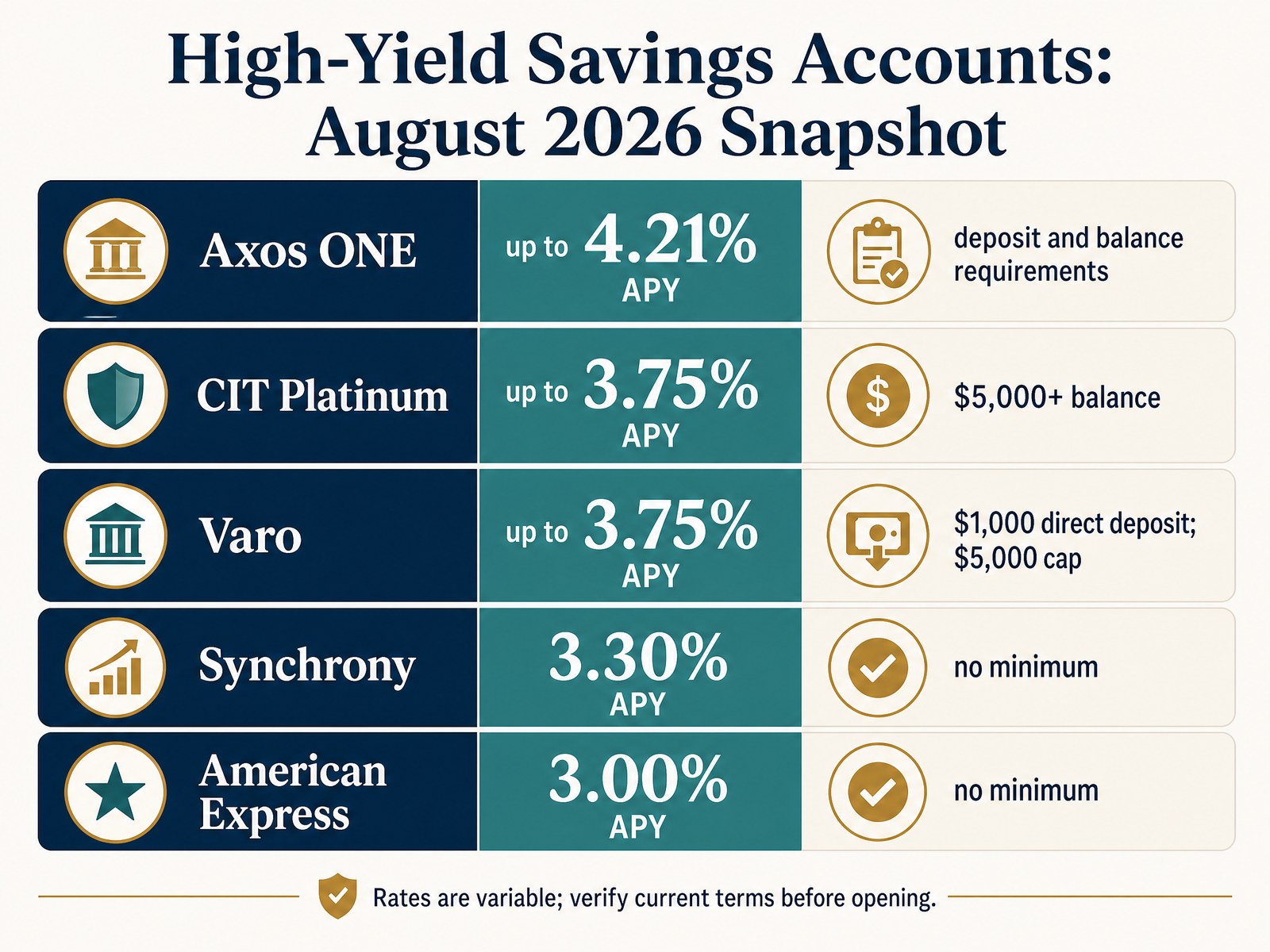
Headline APY is only one part of the decision. Requirements and balance tiers can change the result.
Side-by-side account comparison
| Account | APY and rate date | Opening deposit | Monthly fee | Balance or deposit requirements | Insurance |
|---|---|---|---|---|---|
| Axos ONE | Up to 4.21%; official page checked Aug. 20, 2026 | No minimum to earn interest | $0 | Top rate requires $1,500 qualifying direct deposits plus $1,500 average daily balance, or $5,000 qualifying deposits plus $5,000 average daily balance | FDIC |
| CIT Platinum Savings | Up to 3.75%; APY terms effective July 1, 2026 | $100 | $0 | 0.25% below $5,000; 3.75% at $5,000+ | FDIC |
| Varo Savings | Up to 3.75%; APY accurate July 1, 2026 | No minimum balance | $0 | Requires at least $1,000 qualifying direct deposit and positive Varo balances; top rate capped at $5,000 | FDIC |
| Synchrony High Yield Savings | 3.30%; APYs accurate Aug. 19, 2026 | No minimum deposit | $0 | No minimum balance | FDIC |
| American Express Online Savings | 3.00%; official page checked Aug. 19, 2026 | No minimum balance | $0 | No minimum balance required to open, avoid fees, or earn the disclosed APY | FDIC |
APYs are variable and may change without notice. The table is a research snapshot, not a guarantee of future earnings. Always review the bank’s current disclosures before applying.
What to compare beyond APY
1. Requirements for the advertised rate
Read the conditions behind the headline. Axos requires qualifying deposits and an average balance for its top rate. Varo requires qualifying direct deposits and limits the 3.75% rate to the first $5,000. CIT uses a balance tier, so a small balance earns much less than the headline APY.
2. Fees and minimums
A monthly fee can erase the benefit of a higher APY, especially on a small emergency fund. All five accounts in this comparison advertise no monthly maintenance fee, but you should still check fees for wire transfers, expedited transfers, returned payments, and other services.
3. Deposit insurance
Confirm that the institution is FDIC-insured before depositing money. The standard FDIC coverage limit is $250,000 per depositor, per FDIC-insured bank, for each ownership category. [2] Insurance protects eligible deposits if an insured bank fails; it does not protect you from every type of loss or from a rate changing.
4. Access and transfer speed
A savings account is useful only if you can access the money when needed. Check transfer timing, external-account linking, mobile features, customer support, and whether the account includes an ATM card. American Express says external-account linking can take up to two days. [7]
5. Variable-rate risk
High-yield savings accounts usually have variable rates. The bank can change the APY after you open the account. That makes these accounts useful for liquid cash, but different from a CD with a fixed rate for a defined term.
Account-by-account breakdown
Axos ONE: best headline rate, more conditions
Axos ONE advertises up to 4.21% APY on savings. To unlock that rate, you need either $1,500 in qualifying monthly direct deposits and a $1,500 average daily balance, or $5,000 in qualifying monthly deposits and a $5,000 average daily balance. Balances of $250,000 or more receive a lower 3.50% tier under the official disclosure. [3]
Choose Axos if: you already meet the deposit requirements and want to maximize the rate. Skip it if: you want a savings account with no recurring qualification steps.
CIT Platinum Savings: best for $5,000 or more
CIT advertises up to 3.75% APY, but the account uses a sharp balance tier. Balances below $5,000 earn 0.25% APY under the current disclosure, while balances of $5,000 or more earn the headline rate. CIT lists a $100 minimum deposit and no monthly fee. [4]
Choose CIT if: you can keep at least $5,000 in the account. Skip it if: your balance will often fall below the top-tier threshold.
Varo Savings: best for qualifying direct deposits
Varo starts at 1.00% APY and can pay 3.75% on balances up to $5,000 when you receive at least $1,000 in qualifying direct deposits and end the month with positive Varo balances. Meeting the requirements in one month unlocks the higher rate for the following month. [6]
Choose Varo if: your paycheck or benefits already qualify as direct deposit and your savings balance is within the $5,000 cap. Skip it if: you want the same APY on a larger balance.
Synchrony High Yield Savings: best for simplicity
Synchrony advertises a 3.30% APY with no minimum deposit, no minimum balance, and no monthly fee. Its official page states that the APY was accurate as of August 19, 2026 and may change after the account is opened. [5]
Choose Synchrony if: you want a straightforward account without a balance or direct-deposit hurdle. Skip it if: you are willing to manage conditions to chase a higher rate.
American Express Online Savings: best for a simple established brand
American Express Online Savings advertises a 3.00% APY, no minimum balance, no monthly fee, and FDIC insurance. The official page says no minimum balance is required to open the account, avoid a fee, or earn the disclosed APY. [7]
Choose American Express if: you prefer a simple account from an established online banking brand and do not need the highest rate in this list. Skip it if: another account offers a materially higher APY with requirements you can comfortably meet.
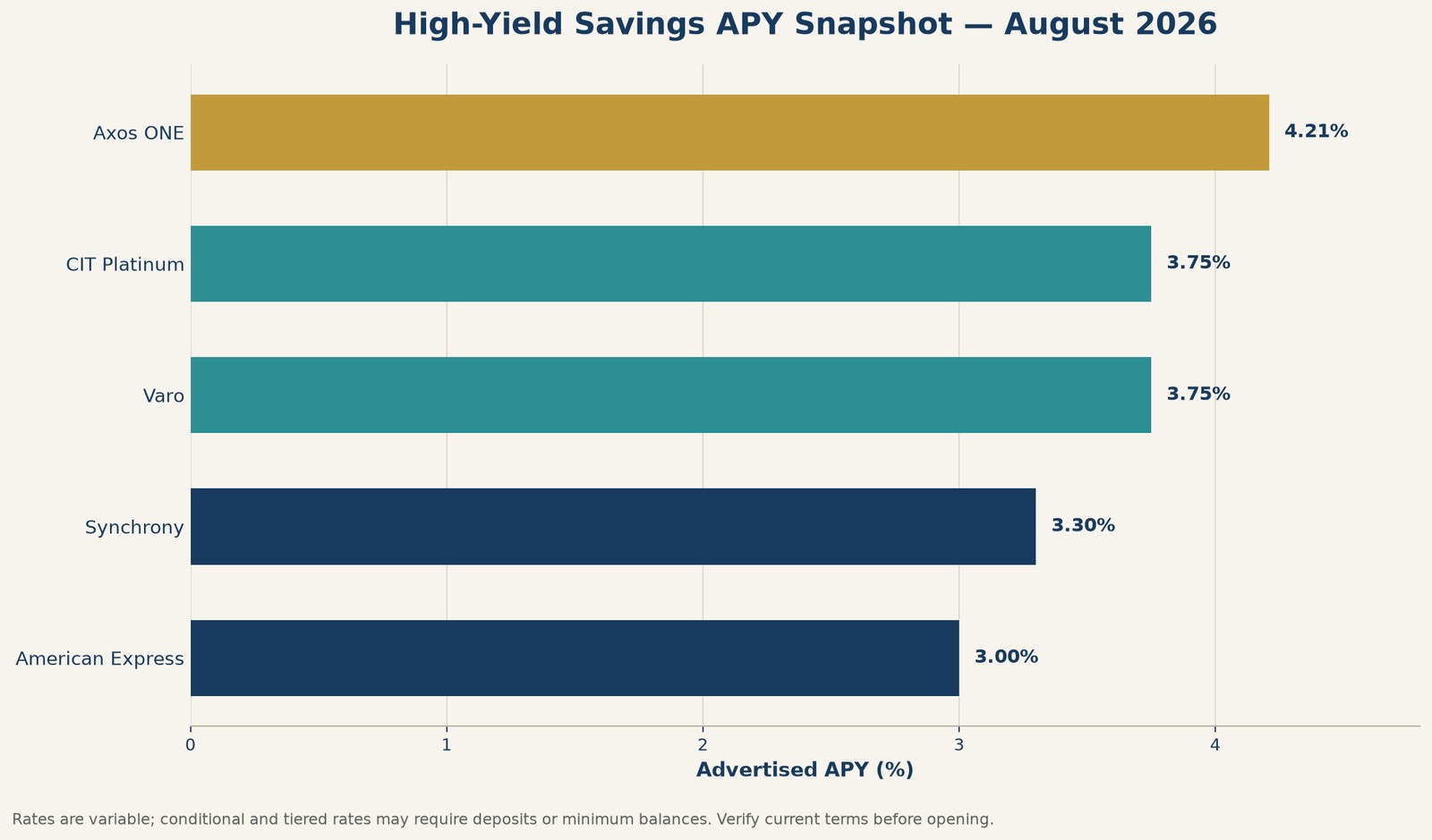
APY comparison shown as a dated snapshot; conditional and balance-capped rates require careful reading.

Review account terms, transfer timing, and requirements before opening a savings account.
Safety, insurance, and access
A high-yield savings account is generally designed for cash you want to protect and access, not money you need to invest for long-term growth. Keep your emergency fund and near-term savings separate from money you can leave invested for years. For help sizing an emergency fund, see Emergency Fund: How Much Do You Actually Need in 2026?
Before opening an account, check the bank’s insurance status, the exact APY disclosure, transfer timelines, and account agreement. APY is a standardized way to express the annual yield after compounding, but it does not lock the rate. Consumer deposit rules require institutions to disclose APY, interest rates, and minimum-balance requirements. [8]
Frequently asked questions
Are high-yield savings accounts safe?
They can be a relatively low-risk place for cash when the bank is FDIC-insured and you stay within applicable coverage limits. Insurance does not prevent the APY from changing, and it does not make every financial product at a company an insured deposit.
What is the best high-yield savings account?
There is no single best account for every saver. Axos ONE has the highest headline rate in this comparison, CIT favors balances of $5,000 or more, Varo favors qualifying direct-deposit users, and Synchrony or American Express offer simpler no-minimum structures.
Can the APY change after I open the account?
Yes. Savings-account APYs are usually variable. Review the account’s current disclosure periodically, especially when market rates change or when a promotional period ends.
How much money should I keep in a high-yield savings account?
Use the account for emergency savings, planned expenses, and cash you may need soon. The right amount depends on your income stability, essential expenses, dependents, and access to other funds. Do not choose a savings target only because it unlocks a higher APY.
Bottom line
The best high-yield savings account is the one whose rate, requirements, insurance, fees, and access fit your real financial life. If you can meet the deposit requirements, Axos ONE offers the strongest headline APY in this comparison. If you keep $5,000 or more in savings, CIT is worth examining. If you want fewer conditions, Synchrony and American Express are simpler choices. Varo makes the most sense when you already receive qualifying direct deposits and keep no more than $5,000 in the high-rate tier.
Before moving your money, compare the current APY, read the disclosures, confirm FDIC insurance, and check how quickly you can transfer funds out. For broader savings guidance, read How Much Should You Save Each Month? If your cash is also earmarked for debt payments, compare the account decision with your student loan repayment plan.
Disclosure: This article is educational content, not personalized financial advice. APYs, fees, eligibility rules, and account terms can change. Verify current terms directly with the bank before opening an account. Some links may be monetized in the future; editorial comparisons should remain independent of compensation.
References
- FDIC, National Rates and Rate Caps
- FDIC, Understanding Deposit Insurance
- Axos ONE official account page
- CIT Platinum Savings official account page
- Synchrony High Yield Savings official account page
- Varo official high-yield savings account page
- American Express Online Savings official account page
- CFPB, Regulation DD: Truth in Savings