Debt Avalanche vs. Debt Snowball: Which Is Better?

Debt avalanche and debt snowball are two debt repayment strategies for deciding which debt receives your extra payment first. The avalanche method targets the highest interest rate. The snowball method targets the smallest balance. Both methods require you to keep making the required minimum payment on every other account.
Short answer: Choose the debt avalanche if reducing interest is your main priority and you can stay motivated while the first balance takes time to disappear. Choose the debt snowball if quick wins help you keep going. Neither method works well if your plan leaves you unable to pay for essential expenses or required minimums.
The Consumer Financial Protection Bureau describes the highest-interest-rate and snowball approaches as two basic debt-reduction strategies. It also emphasizes understanding what you owe, organizing bills, and keeping minimum payments current. [1]
Table of contents
- Debt avalanche vs. debt snowball: Which Is Better for You?
- How the debt avalanche works
- How the debt snowball works
- Worked example
- Debt-payoff calculator assumptions
- How to compare the cost
- Which method should you choose?
- Protect the plan from setbacks
- Frequently asked questions
- Bottom line

Debt avalanche vs. debt snowball: quick comparison
| Factor | Debt avalanche | Debt snowball |
|---|---|---|
| Target first | Highest interest rate | Smallest balance |
| Main goal | Reduce interest cost | Create visible progress |
| Minimum payments | Pay required minimums on all other debts | Pay required minimums on all other debts |
| Payment rollover | Move the finished payment to the next-highest rate | Move the finished payment to the next-smallest balance |
| Best fit | People who prefer a math-first approach | People who benefit from quick wins |
| Cost | No special fee to use the method; interest depends on balances, rates, and payments | No special fee to use the method; interest depends on balances, rates, and payments |
| Main risk | Motivation may fall if the first payoff is slow | Interest cost may be higher when a high-rate debt waits |
Quick verdict: The avalanche is usually the math-first choice for reducing interest, while the snowball is the motivation-first choice for creating visible wins. Actual results depend on balances, rates, minimums, payment amount, and whether new charges are added.
Neither method is a loan or financial product. You do not pay a fee to use either method. The cost difference comes from how your balances, interest rates, minimum payments, and extra payment amount interact over time.
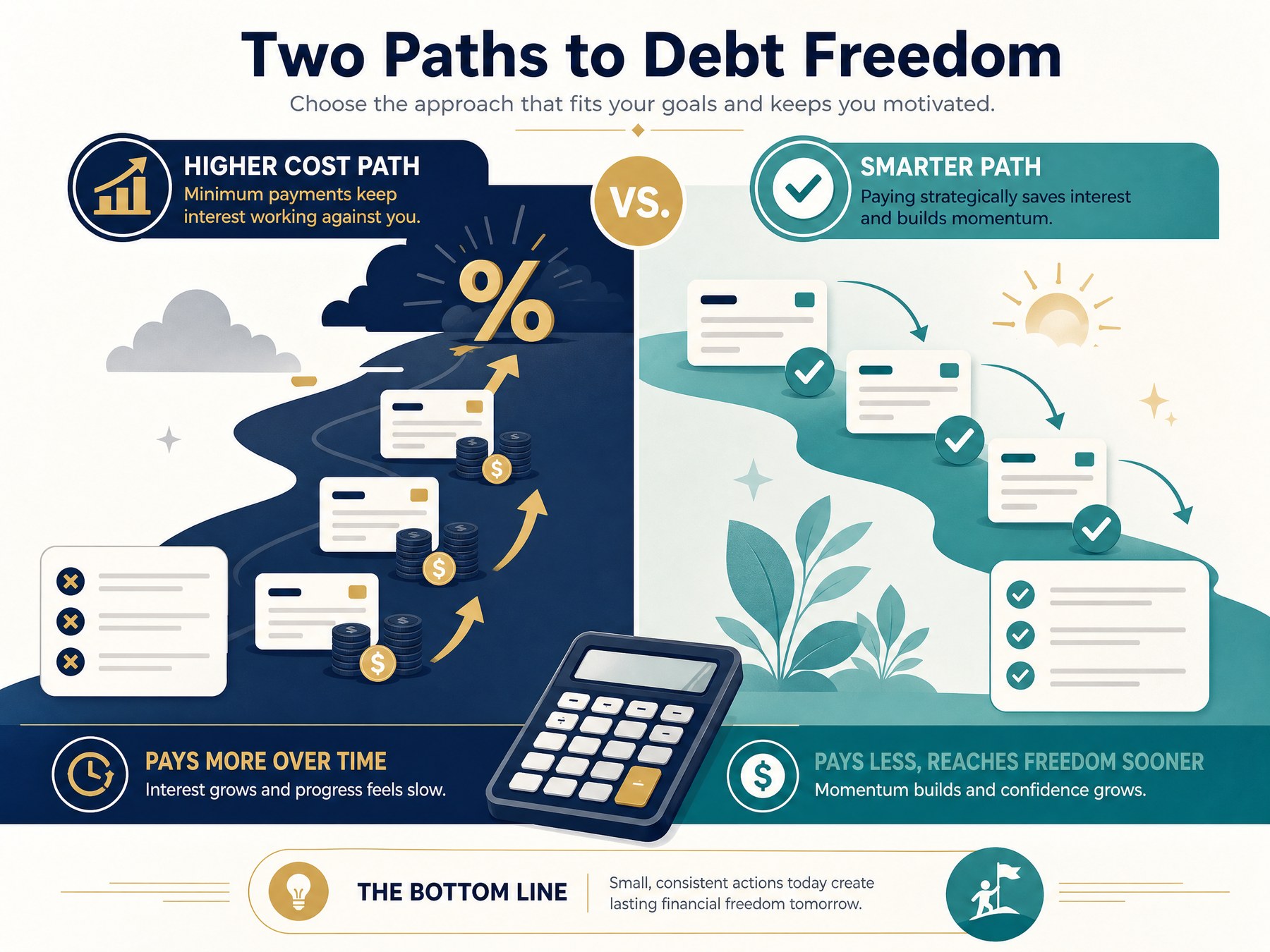
How the debt avalanche works
List your debts from the highest interest rate to the lowest. Pay the required minimum on each account. Then direct every available extra dollar to the debt at the top of the list. When that debt is paid off, add its former payment to the next debt.
The avalanche method can reduce interest because it attacks the balance that is charging the highest rate first. The advantage is most meaningful when the rates are far apart or when the high-rate balance is large. The trade-off is emotional: the first target may not disappear quickly, especially if it has a large balance.
How the debt snowball works
List your debts from the smallest balance to the largest. Pay the required minimum on each account, then direct extra money to the smallest balance. After the first debt is gone, roll that payment into the next-smallest balance.
The snowball method can create an early success that makes the plan easier to continue. That motivation has value because a mathematically efficient method does not help if you stop using it. The trade-off is that a higher-rate balance may continue collecting interest while you eliminate a smaller debt.
Worked example: three illustrative debts
Assume the following household has three debts and can make the minimum payments plus an additional $200 each month. The figures are illustrative and do not predict a payoff date or total interest cost.
| Debt | Balance | Interest rate | Minimum payment |
|---|---|---|---|
| Card A | $2,400 | 29.99% | $75 |
| Card B | $1,100 | 22.99% | $35 |
| Card C | $600 | 19.99% | $25 |
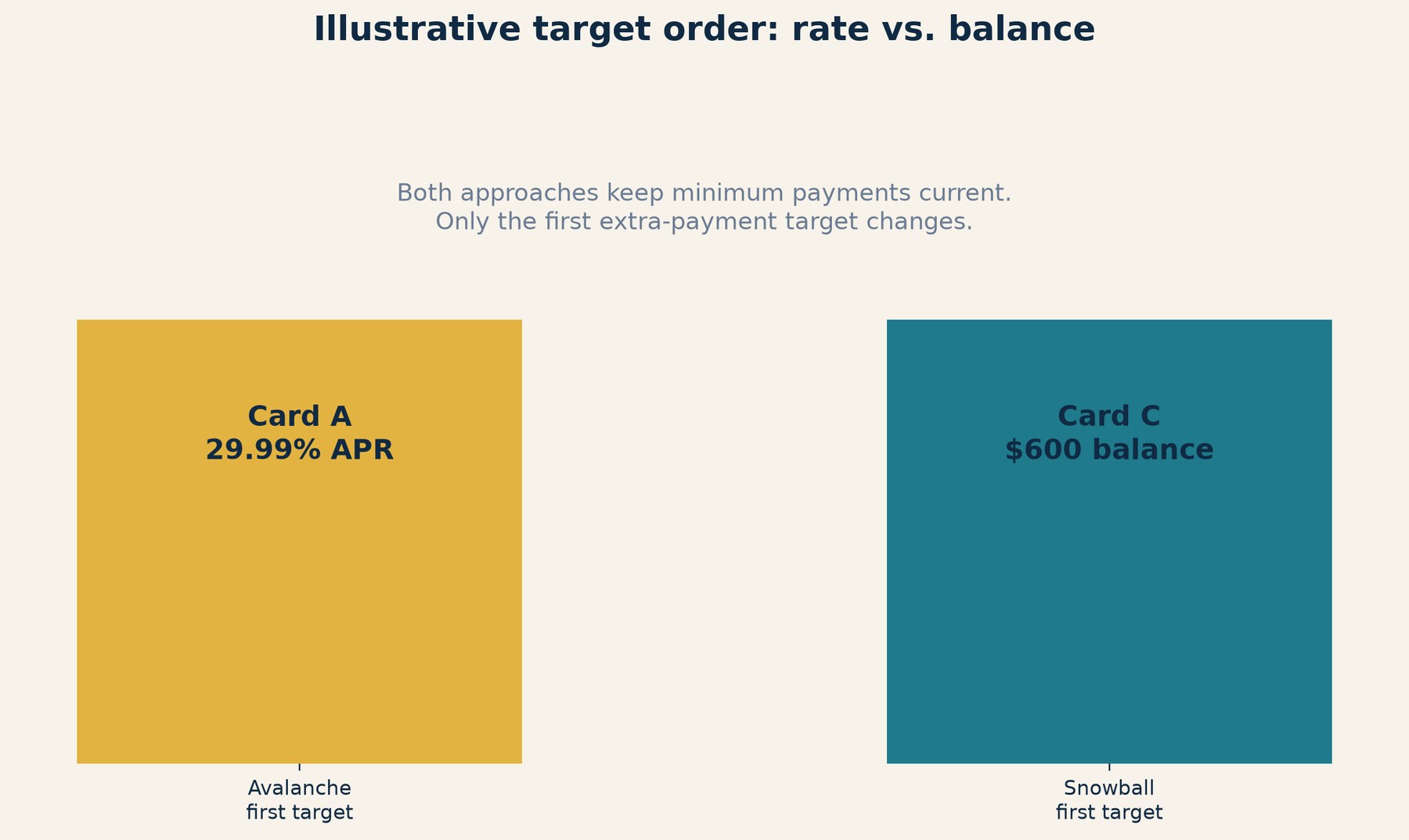
The avalanche order is Card A, Card B, then Card C because Card A has the highest rate. The snowball order is Card C, Card B, then Card A because Card C has the smallest balance. Both plans begin with $135 in total minimum payments and direct the additional $200 to the first target, but they prioritize different outcomes.
Debt-avalanche and snowball calculator assumptions
A fair comparison keeps the starting balances, interest rates, minimum-payment rules, extra payment, and new-charge assumptions the same. A spreadsheet or calculator can estimate payoff time and interest, but it cannot measure motivation, income changes, or the likelihood that new charges will be added.
How to compare the cost
To compare the methods, use the same starting balances, interest rates, minimum-payment rules, extra payment, and assumptions for both. Then calculate the estimated payoff time, total payments, and interest. If you do not know the issuer’s minimum-payment formula, label the result as an estimate rather than a promise.
A calculator can show the mathematical difference, but it cannot measure motivation, stress, income changes, or the likelihood that new charges will be added. Treat the calculation as one input. A method that saves slightly less interest but prevents you from abandoning the plan may produce a better real-world result.
Which method should you choose?
Choose the avalanche method if you value lower interest cost
The avalanche may fit you if you can follow a spreadsheet or written list, have a large difference between interest rates, and are comfortable waiting longer for the first balance to disappear. Keep the list current because a promotional rate, balance change, or new account can change the order.
Choose the snowball method if visible progress keeps you engaged
The snowball may fit you if paying off a small account would reduce stress, simplify your monthly bills, or give you momentum. Check the interest trade-off first, but do not ignore the behavioral benefit of seeing an account reach zero.
Use a hybrid approach only with a clear reason
Some people pay off a very small balance first, then switch to the highest-rate debt. Others prioritize a debt with a temporary rate increase or an account that is close to its limit. If you use a hybrid plan, write down why you changed the order so the decision remains deliberate.
Protect the plan from setbacks
Keep a small cash buffer if your budget allows so an ordinary surprise does not immediately go back on a credit card. If your cash flow is already tight, read How to Stop Living Paycheck to Paycheck for a broader plan. For student-loan balances, read the student-loan repayment guide because federal and private loans may have different rules.
If you cannot make a minimum payment, contact the lender promptly rather than quietly skipping it. CFPB guidance also warns consumers to be cautious with companies that promise to erase debt, charge before providing promised relief, or tell people to stop making minimum payments. [2]

Frequently asked questions
Does the debt avalanche always save more money?
When the same balances, rates, minimums, and extra payment are used, targeting the highest rate first generally reduces interest compared with targeting a lower-rate balance first. Actual results depend on account terms, new charges, payment changes, and the assumptions in the calculation.
Is the debt snowball better for beginners?
It can be easier for some beginners because a small balance may disappear sooner. It is not automatically better for everyone. Compare the interest trade-off and choose the method you can continue.
Should I pay minimums on every debt?
Unless your lender gives you a different arrangement, your plan should account for the required minimum on each debt. If you cannot make a minimum, contact the lender and ask about available assistance before missing the payment.
Bottom line
The debt avalanche is the math-first choice: it sends extra money to the highest interest rate. The debt snowball is the momentum-first choice: it sends extra money to the smallest balance. Keep minimum payments current, stop new balances from growing, and use the method that gives you the best combination of cost control and follow-through.
Disclosure: This article is educational content, not personalized financial advice. Your debt strategy should reflect your income, obligations, interest rates, goals, and risk tolerance. Consider a qualified nonprofit credit counselor or financial professional for help with your specific situation.
References